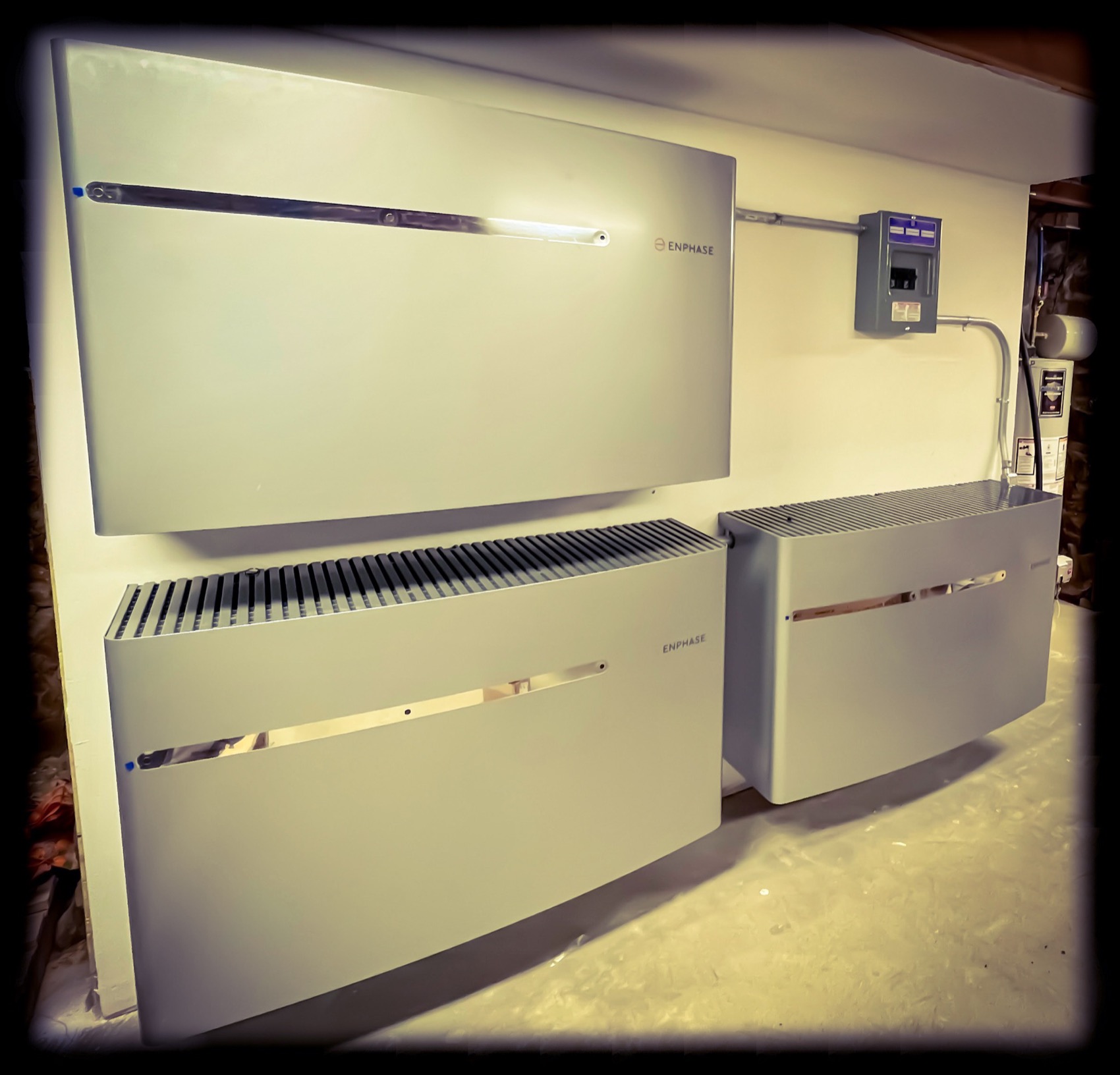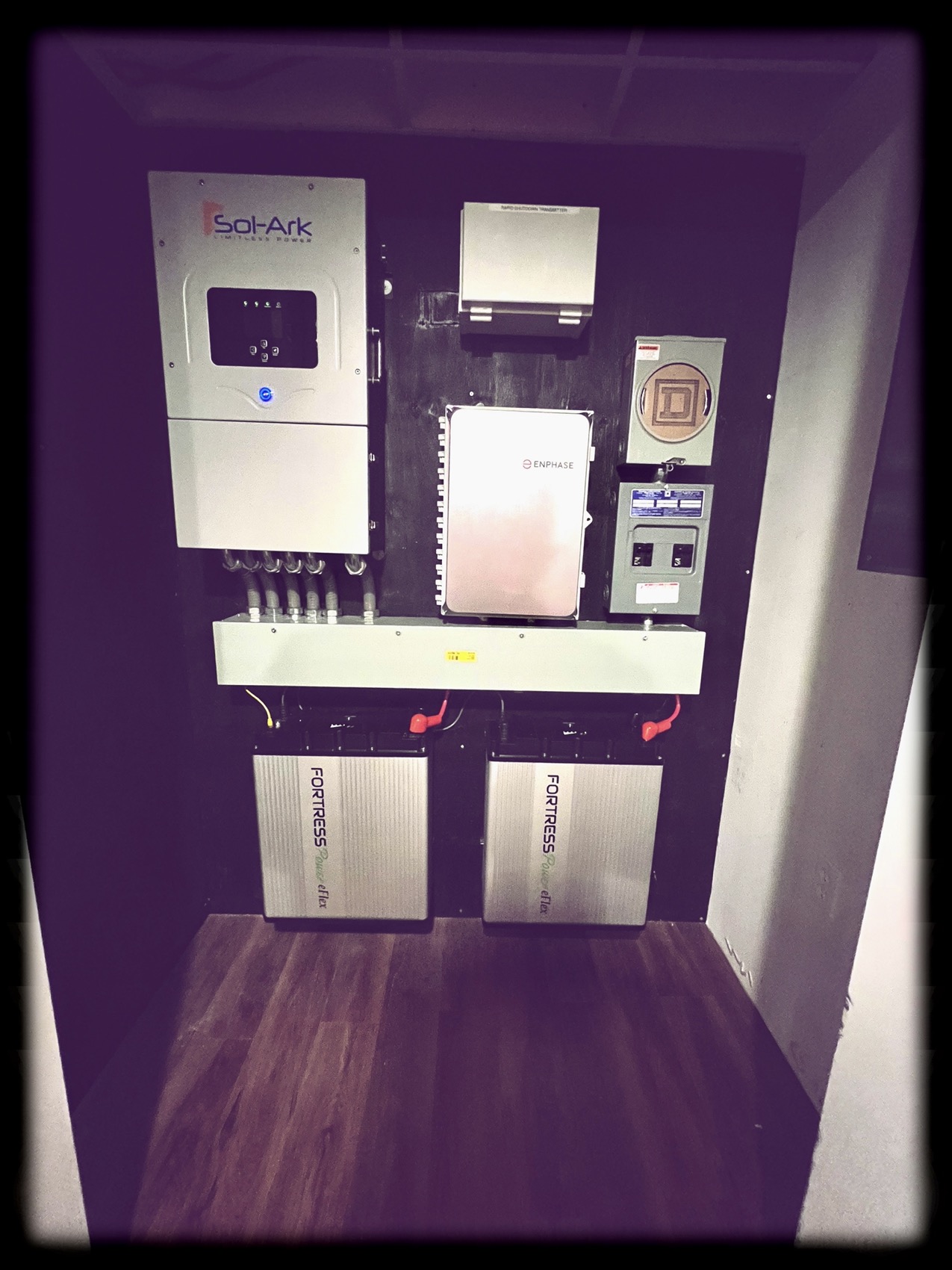
We reach for EG4 and Sol-Ark on backup builds because they are all-in-one hybrid inverters we stock, train on and service with our own people. A fault on a Tuesday in Dingman Township should not turn into a six week parts hunt. EG4's 18kPV covers most houses in this footprint. Sol-Ark gets the call when the site is harder or there is a generator in the mix. If your array already works, we usually AC couple instead of replacing anything. Solar Bear does not service Tesla systems.
What a backup build actually has to do
Strip the brochures away and a residential backup system has four jobs. Sense the grid going down and open fast enough that your lights barely blink. Carry the starting surge of a well pump or a condenser without folding. Charge back up from solar the next morning without a person touching anything. And sit on a wall in a Pocono garage through a February cold snap and an August attic heat wave without quitting.
Everything else is preference. The reason we narrowed our stocking list instead of switching brands every quarter is parts and firmware. When we own the brand relationship, we have the replacement board on the shelf, the settings file from the last twenty installs, and a tech support number that knows us. That matters more on day 900 than any spec on day one.
If you are earlier in the process and still deciding whether storage makes sense at all, start with our battery backup guide for the Poconos and then come back here for the equipment reasoning.
Why the EG4 18kPV comes off the shelf first
The 18kPV is our default on a new solar and battery build. EG4's own spec sheet describes it as a 48 volt split-phase hybrid with AC coupling capability and three MPPTs, and lists a 10-year standard warranty on the unit. EG4 publishes the full terms on its 18kPV warranty page, including the registration and transfer language, which is worth five minutes of your time before you sign anything with anybody.
Three practical reasons it wins most of the time.
Three MPPTs means awkward roofs stop being a problem. Houses here are rarely one clean rectangle facing south. A chalet with a dormer, a ranch with a garage wing at a different pitch, a roof with a stand of oaks clipping the west plane in late afternoon. Separate trackers let those planes behave independently instead of dragging each other down. If shade is your main constraint, read what we do with tree shade in the Poconos before you pick an inverter at all.
AC coupling capability on the same box. That gives us a path if you later add an array on a barn or a ground mount, or if we are integrating something that already exists.
It is one enclosure. Fewer boxes on the wall means fewer terminations, fewer places for water to find, and a cleaner inspection. Electrical inspectors in this corner of Pennsylvania see a lot of mediocre work. A tidy single-enclosure install gets looked at differently than a wall covered in conduit bodies.
We usually pair the 18kPV with EG4 wall-mount batteries. On the 14.3 kWh PowerPro WallMount All Weather unit, EG4 publishes a 10-year prorated parts or product replacement warranty and requires registration within the first year, or proof of purchase from an authorized distributor, for the coverage to stay valid. We register them for you on handoff. If you want the battery outdoors or in an unheated space, we check the temperature rating on the specific model rather than assuming the brand is rated for it. Where the box goes is its own decision, covered in where to install a home battery.
Why Sol-Ark gets the call on the harder houses
Sol-Ark is what we reach for when the site has a complication the 18kPV would have to be talked into. A generator already on the property that the owner wants integrated rather than orphaned. A long rural service with voltage that wanders. A house where the owner has lived through enough outages to want more headroom than the load calc strictly requires.
Sol-Ark publishes a 10-year limited warranty on the 12K-2P-LL covering defects in materials and workmanship, with the term starting at the initial purchase date. Read that document rather than a dealer's summary of it, including the registration requirement.
The honest version: on a straightforward Milford Borough colonial with a newer 200 amp panel and a clean south roof, the two brands land in nearly the same place and we will recommend the one we can get on your schedule. The gap opens up on the odd sites. Lackawaxen camps converted to full-time houses, Shohola properties at the end of a long single-phase run, anything where the loads list includes a shop.
Send us a photo of your main service panel and the name of the utility that bills you, and we will tell you which of these two we would spec and why. If you already have solar, add a photo of the inverter label. Start with the panel photo or look at what we have built nearby.
How the three paths compare
| EG4 18kPV | Sol-Ark 12K or 15K | AC-coupled retrofit on existing SMA or SolarEdge | |
|---|---|---|---|
| Why we pick it | New PV and storage going in together | Generator integration, rough service, more headroom wanted | The array already works and you only want backup |
| Solar wiring | DC strings into the hybrid, three MPPTs | DC strings into the hybrid | Existing inverter stays where it is, battery couples on the AC side |
| Published inverter warranty | 10-year standard, per EG4 | 10-year limited on the 12K-2P-LL, per Sol-Ark | Whatever the original inverter already carries |
| Typical mounting | Garage wall, basement, utility room | Garage wall or exterior, depending on model rating | Beside the existing equipment, near the meter |
| Usual panel work | Backup loads panel, or whole-home if the main allows | Same question, often more room to work with | Backup loads panel in most cases |
| What we need from you first | Panel photo, twelve months of usage, utility name | Same, plus generator make and model | Inverter label photo and array layout |
For the retrofit column, the detail is in adding a battery to existing solar with AC coupling. We service SMA, SolarEdge, SunPower, Sungrow, APsmart and Generac equipment as well, which is the whole list in the equipment we install and what we do not service.
What we will not put on a house
This is the part most equipment posts skip.
Anything with no US service desk. There are hybrid inverters sold into this market whose warranty process is an email address and a shipping label to a freight forwarder. When that unit faults in January, you are the one without heat while somebody decides whether it is covered. We will not be the installer who put it there.
Batteries without listing documentation we can hand an inspector. If the manufacturer cannot produce the listing paperwork for the exact model, the AHJ is within their rights to reject it, and they sometimes do. Pennsylvania's Uniform Construction Code is administered by the Department of Labor and Industry, and which code editions your township enforces is a question for your code official before the design is final, not after the battery is on the wall.
Tesla systems. Solar Bear does not service Tesla equipment. Not the batteries, not the inverters, not the gateway. If that is what you own, we are not your contractor and we would rather say it now than after a site visit.
Whole-home backup on a panel that cannot carry it. The brand on the inverter does not change the physics of your service. If the main is an older bus with no room, the right answer is usually a backup loads panel, which we explain in critical loads panel design. Panel condition drives more of our designs than anything else, which is why we wrote a whole post about the main service panel.
The local wrinkle: your utility has an opinion about the model
The inverter you want is not automatically the inverter you are allowed to interconnect. In Pennsylvania, net metering and interconnection for customer-generators run through the Commission's rules at 52 Pa. Code Subchapter B, and PPL's own smart inverter supplement states that customer-generator and third party applications must use certified inverters complying with the certification section of those rules. In practice that means the model and firmware revision go on the application, and changing hardware after approval can mean going back around.
Which utility serves you is decided by your address, not your township line. Houses a mile apart in Westfall or Montague can bill to different companies. Tell us who sends your bill and we will build the application to that utility's current process. The sequence, and how long each step tends to take, is laid out in our permit and interconnection timeline.
One more thing on budgeting, because it affects how people size these builds. The federal residential clean energy credit is over. The IRS states that the section 25D credit is not allowed for expenditures made after December 31, 2025. Anyone still planning your project around it is working from last year's script. We wrote the longer version in the truth about the 2026 credit picture.
Who this is not right for
A hybrid inverter build is the wrong tool in a few common situations, and we would rather lose the job than install into one of them.
You lose power twice a year for an hour. If your outages are short and rare and you have no medical equipment, no well and no sump, storage may be a want rather than a need. Say that out loud and decide on those terms.
You need to run a whole house for four days, every time. Battery capacity at residential scale is finite. For very long outages with heavy loads, a generator still has a role, and sometimes the honest answer is both. We compared them in battery versus standby generator.
Your roof is near the end of its life. Putting an array on decking that needs replacing inside a few years means paying to remove and reset it. We handle roofing too, and our sister company All In One Building LLC does the larger roof work, so we can sequence it properly instead of pretending the problem is not there.
You are shopping on price alone. We are not that contractor. The stocking list exists so we can stand behind the work for years, and that costs something.
What we would tell a homeowner considering this
Pick the installer before you pick the inverter. The brand matters less than whether whoever installed it will answer the phone in year six and has the part on a shelf in Milford. Ask any contractor you are talking to which models they stock, who does their service calls, and what happens when a board fails outside business hours.
Then get specific about your own house. Twelve months of usage, a photo of the panel, your actual outage history, and which loads you refuse to live without. That list produces the design. The badge on the enclosure follows from it.
If you want to talk it through, the office line is (570) 500-2327, or send the details through our contact form. You can see the full scope of what we do on the services page, and if you are weighing how you want to own the system, ownership versus a PPA is the other decision worth making early.
What we would tell a homeowner considering this
- We default to EG4 and Sol-Ark on backup builds because we stock both, train on both and service both ourselves.
- EG4 publishes a 10-year standard warranty on the 18kPV, and Sol-Ark publishes a 10-year limited warranty on the 12K-2P-LL. Read the registration terms before you buy anything.
- If your array already works, AC coupling a battery to the existing inverter is often the less disruptive path.
- Solar Bear does not service Tesla systems. If you own one, we are not the right call.
- Your main service panel, not the inverter brand, usually decides whether you get whole-home backup or a backup loads panel.