
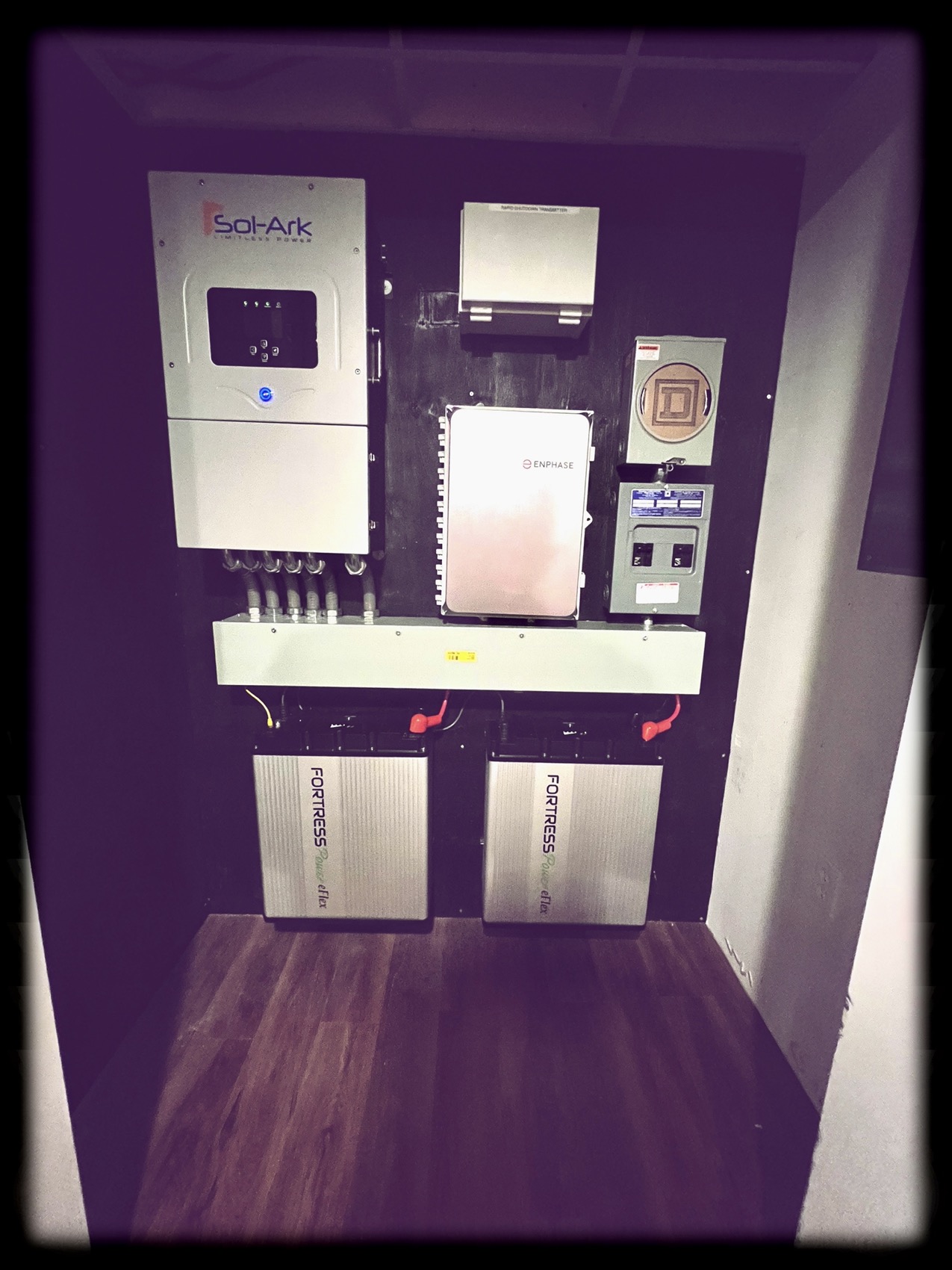
A home battery in this climate wants a dry, semi-conditioned space with a solid wall, clear floor in front of it, and no sleeping room on the other side of the drywall. In practice that means a basement utility area, the inside wall of an attached garage, or an outdoor-rated unit on an exterior wall. Unheated detached barns, crawl spaces and attics are the three places we talk people out of. The wall matters, the temperature matters, and your inspector has opinions about both.
The four places a battery actually ends up
Almost every residential battery we set in the Tri-State corner lands in one of four spots.
The basement utility area is the most common, because the main panel is usually already down there and the temperature barely moves across the year. The attached garage is second, and it is often the better engineering answer in a house where the basement is finished or damp. The exterior wall, with a unit rated for outdoor installation, comes up on slab houses and on additions where there is no mechanical room left. The detached garage or barn is the one people ask for and the one we most often push back on.
What drives the choice is rarely aesthetics. It is the distance to the main service panel, whether the wall can carry the weight, whether a person can stand in front of the equipment with a meter in their hand, and what the space does in February. If you have not read our guide to battery backup in the Poconos yet, that one covers what a battery does during an outage. This one is about where the box goes.
Cold is the limiter, not heat
Every battery worth installing publishes an operating temperature range, and on the lithium iron phosphate packs we work with the allowable charging range is tighter than the discharging range. That asymmetry is the whole story in a Northeast house. A battery in an unheated space can usually still give you power on a cold morning. Whether it will accept a charge from your array or the grid at that same temperature is the question, and the answer is in the manual for the exact model, not in a brochure. EG4, for one, publishes the range for its wall-mount all-weather unit in the product manual on its own site, and we read that page before we pick a wall.
Outdoor-rated and cold-climate cabinets handle this with internal heating. That heating draws energy, and it draws it from somewhere. In a grid-tied house nobody notices. In a seasonal cabin off Route 739 that sits empty from November to April, it matters, and it is worth saying out loud before the sale rather than after.
Heat is the quieter problem. A battery on the sunny side of a house, on a dark wall with no shade, spends July warmer than the spec sheet wants. Attics are worse, which is why we do not put batteries in them. Unvented attic space in a Milford Township colonial in August is not a place to store energy, and no inspector in this footprint is going to be happy to see one up there.
Garage, basement, exterior wall or outbuilding
| Location | Temperature behavior | Usual code friction | Service access | What goes wrong |
|---|---|---|---|---|
| Basement utility area | Steadiest of the four, little seasonal swing | Wall and ceiling construction around the unit, smoke detection in the space | Good, if the stair and the path stay clear | Water. A sump that has failed once will fail again |
| Attached garage | Swings with the door, still well above outdoor low | Separation from the living space, protection from vehicle impact | Best of the four | The wall fills up with shelving and a second fridge |
| Exterior wall, outdoor-rated unit | Full seasonal swing, managed by the unit itself | Placement relative to doors and windows, meter and disconnect grouping | Good in summer, poor under three feet of snow | Sun exposure, roof runoff, the plow pile |
| Detached garage or barn | Coldest, and uncontrolled | Feeder from the house, disconnect at the structure, sometimes a second permit | Fine, until you need to walk out there in a storm | Charging range in deep winter, rodents in the conduit |
Nothing in that table is a rule. It is the pattern across the houses we work on, and the one column that decides more jobs than the others is service access. A battery is a piece of equipment with a service life. Somebody is going to open it.
Not sure which of your walls is the right one? Send us the address, a photo of your main panel with the door open, and a photo of the space you were picturing. We will tell you what fits there and what it would take, and if the answer is that your house is a better candidate for something else, we will say that too. Start on the contact page or look through recent battery and solar work first.
Clearances, and the wall behind the box
Three physical things kill more otherwise good battery locations than anything else.
Working space. The electrical code sets a required clear depth and width in front of equipment you have to service, and it is measured from the face of the box out into the room. It has to be clear on install day and it has to still be clear in four years. The storage shelf that goes up next spring is the problem, not the installation.
Wall construction. The energy storage section of the residential code is specific about what the walls and ceiling around a battery have to be when it sits inside a dwelling. That is why the inside face of a garage wall is often easier than a finished basement rec room, and why the answer depends on the house rather than the town. A plan reviewer will ask. Have the answer before the drawings go in.
Weight and framing. Wall-mounted batteries are heavy, and the mounting bracket needs real framing behind it. In older Milford and Port Jervis housing stock with furring strips over masonry, or with a half-finished basement wall, the fastening detail is a design decision and not a field guess. On block and stone foundations we often end up with a floor-standing unit instead.
The other constraint that catches people is the main service panel. If your panel has no room, or the bus rating will not take the interconnection, the battery location follows the panel work rather than the other way around. We wrote that up separately in how your main service panel shapes the design, and it is worth reading before you commit to a wall.
Which code book your inspector is holding
This is the part that changed recently, and it changed in all three states.
In Pennsylvania, the 2021 ICC family of codes was adopted into the Uniform Construction Code and took effect statewide at the start of this year, per the Department of Labor and Industry adoption report. In New York, the 2025 Uniform Code took effect on December 31, 2025, and it incorporates the 2025 Residential Code of New York State, which the Department of State describes as a derivative of the 2024 International Residential Code. In New Jersey, one and two family work runs under the 2021 International Residential Code, New Jersey edition, and the Department of Community Affairs adopted the 2021 I-Codes along with the 2020 National Electrical Code effective September 6, 2022.
What that means for you is simple. A battery installed in your neighbor's garage three years ago was reviewed under a different edition than yours will be. Do not use it as a precedent, and do not let anybody tell you a location is fine because it was fine last time.
Which municipality reviews your permit, and which code official signs it, is decided by your address. Pike County townships, Orange County villages and Sussex County boroughs do not all run their inspections the same way. Ask your code office which edition they are enforcing and whether they want the energy storage details shown on the drawings. We do that call as part of the design, but you are allowed to make it yourself.
What the inspector looks at on the day
The final is not mysterious. In our experience across this footprint, it comes down to a handful of things.
The listing label on the unit, still legible and matching what was on the approved drawings. The disconnecting means, where it is and whether it is labeled. The placards at the service, so a Blooming Grove volunteer firefighter at two in the morning can tell at a glance that the house has stored energy in it. Clear working space in front of the equipment. Mounting, fasteners, and whether the thing is actually tied to framing. Smoke detection in the space. Conduit support and workmanship, which is where sloppy crews get caught.
If any of that was shown one way on the drawings and built another way, that is a reinspection. The permit and interconnection timeline post walks through where that sits in the overall schedule.
Who this is not right for
Some houses should not get a battery on any wall, and we would rather say so here than at your table.
Seasonal cabins left unheated all winter. If nobody is there from November to April and the structure is not kept above freezing, a battery is the wrong tool unless you go to an outdoor-rated, heated cabinet and accept what that costs you in standby energy.
Houses where the only candidate location is a finished bedroom wall or a bedroom closet. That is a hard no, not a negotiation.
Houses where the real goal is days of heat and well water during a long outage. A battery is excellent at covering the common short outage and shaving your worst load hours. If what keeps you up at night is a five-day ice storm event on a well and a boiler, read our comparison of home batteries and standby generators first. Sometimes the right answer is a generator, and sometimes it is both.
Tesla owners. Solar Bear does not service Tesla systems. If you have a Tesla battery already on the wall, we are not the company to call for it, and we will tell you that on the first phone call instead of sending a truck. What we do install and service is listed in the equipment post and on the services page.
Start with the wall, not the brochure
The order most homeowners get this in is backwards. They pick a battery, then look for somewhere to put it. We would rather walk the basement and the garage first, find the two walls that could work, measure the run to the panel, and then pick equipment that fits those constraints. It is a shorter conversation and it produces fewer surprises at inspection.
If you want that walk-through, send an address and a couple of photos through the contact form, or call the office at (570) 500-2327. If you are still deciding what the battery needs to carry in the first place, start with choosing the loads that go on a critical loads panel.
What we would tell a homeowner considering this
- The best spot is usually a dry, semi-conditioned space with a solid wall near the main panel: a basement utility area or the inside wall of an attached garage.
- Cold is the limiter in this climate. Every battery has a published temperature range, and the charging range is usually tighter than the discharging range.
- Clear floor space in front of the equipment is not optional, and it is the detail homeowners most often plan away.
- Which code edition your inspector enforces changed recently in Pennsylvania, New York and New Jersey, so a neighbor's 2023 install is not a precedent.
- Solar Bear does not service Tesla systems.