Because the panel is where your system actually connects, and the panel is what tells us whether the design you want is legal. Roof geometry sets production. The main service panel sets the ceiling: how many amps of inverter output can land there, whether a backfed breaker is even allowed, whether the meter needs to move, and whether a battery can be wired for backup without rebuilding half the branch circuits. We look at the panel first because it is the part of the job that changes the drawings.
The roof is a math problem. The panel is a code problem.
Roof questions have soft answers. A north plane produces less than a south plane. Shade from a hemlock line costs you morning production. Those are numbers on a proposal, and a good designer can trade them off.
Panel questions have hard answers. The busbar in your panel is rated for a specific ampacity, the main breaker protecting it is a specific size, and the National Electrical Code puts a firm limit on how much a solar inverter is allowed to backfeed into that bus. When the math does not work, it does not work. No amount of module efficiency fixes it. That is why a site visit that starts on the roof and ends at the panel usually produces a proposal that gets redrawn.
The section that governs the common load-side connection is NEC 705.12. The version most homeowners eventually hear about is the busbar allowance: with the solar breaker landed at the opposite end of the bus from the main, the rating of the main breaker plus 125 percent of the inverter's continuous output current is allowed to reach 120 percent of the busbar rating. A 200 amp bus with a 200 amp main leaves room. A 100 amp bus with a 100 amp main leaves very little. A 125 amp bus with a 125 amp main leaves almost nothing worth having.
Your inspector reads the edition of the code that your state adopted, not the newest one. In Pennsylvania the adopted editions live in 34 Pa. Code Chapter 403, and the Department of Labor and Industry's Uniform Construction Code page gives February 14, 2022 as the effective date of the 2018 I-code series as reviewed by the Review and Advisory Council. New Jersey adopted the 2020 National Electrical Code as its electrical subcode at N.J.A.C. 5:23-3.16, per the Department of Community Affairs rule documents. For New York work we confirm the edition in force with the agency doing the electrical inspection before we draw anything, because the answer has moved recently and it is their call.
What we are actually reading when we open your panel
Nine things, in this order.
The label inside the cover. It gives the busbar ampacity, the maximum main breaker, and the listed breaker types. This single sticker decides more than the whole roof.
The main breaker. Size, brand, and whether it is a bolt-on or a plug-in. Sometimes derating the main is the cleanest way to make the interconnection fit, and sometimes the loads in the house will not tolerate it.
Free spaces, and which end of the bus they are on. Two open slots at the bottom of a bottom-fed panel are not the same as two open slots at the top. Position matters for the busbar calculation.
Whether the breakers are still made. Some older panels have no listed replacement breaker you can buy. We do not backfeed a panel we cannot buy a correctly listed breaker for, and that is a judgment we would rather make in your basement than on install day.
Tandem breakers and how many. A panel stuffed with tandems is telling you the house has already outgrown it.
Where the meter is, and what it is mounted to. Meter position drives conduit runs, and if the service needs work, PPL publishes the meter service devices it will accept, down to requiring the manufacturer's catalog number to be stamped where it stays visible after the base is installed.
Grounding and bonding. Ground rod, water bond, neutral and ground separation in subpanels. Solar work puts eyes on all of it, and inspectors know that.
Water. In older Pike County and Sussex County houses we find rust streaks in panels mounted on an outside wall behind a downspout. That is a service repair, not a solar upgrade, and it goes first.
The load side story. Well pump, electric water heater, mini splits, a hot tub on the deck, an EV charger someone added on a Saturday. This is where the existing demand calculation comes from. Where we need real numbers instead of assumptions, the code allows an existing installation's load to be established from actual maximum demand data under the conditions in NEC 220.87, including a 30-day recording when a year of data is not available.
Five ways a design deals with a panel that has no room
A full panel is not a verdict. It is a fork in the road. These are the paths, and the honest tradeoffs.
| Approach | What it is | When it fits | What it costs you |
|---|---|---|---|
| Load-side breaker in the existing panel | A backfed breaker in a spare space, sized inside the busbar allowance | Bus rating and main breaker leave headroom, spaces are in the right position | Least schedule and disruption, but caps array size |
| Main breaker derate | Swap the main for a smaller one so the busbar math closes | The demand calculation shows the house genuinely does not need the full main | A load calculation you have to defend, and a hard ceiling on future loads |
| Supply-side tap | Inverter output lands ahead of the main disconnect, on the service conductors, under NEC 705.11 | Panel has no usable spaces but the service itself is sound | A utility disconnect coordination and usually a meter or service touch |
| Service and panel upgrade | New panel, often new meter socket and service conductors | Old undersized service, obsolete breakers, corrosion, or big new loads coming | Longest schedule, permit and utility involvement, most disruption |
| Non-export or power control setup | Inverter or battery limits output so it never exceeds what the bus and the utility allow | Battery-heavy designs, tight busbars, utilities that will not accept storage export | Fewer credits on the bill, and settings an inspector will want to see verified |
Which one we recommend depends on your label, your loads, and your utility. It is the least glamorous conversation in solar and the one that saves the most rework.
What we install once that decision is made
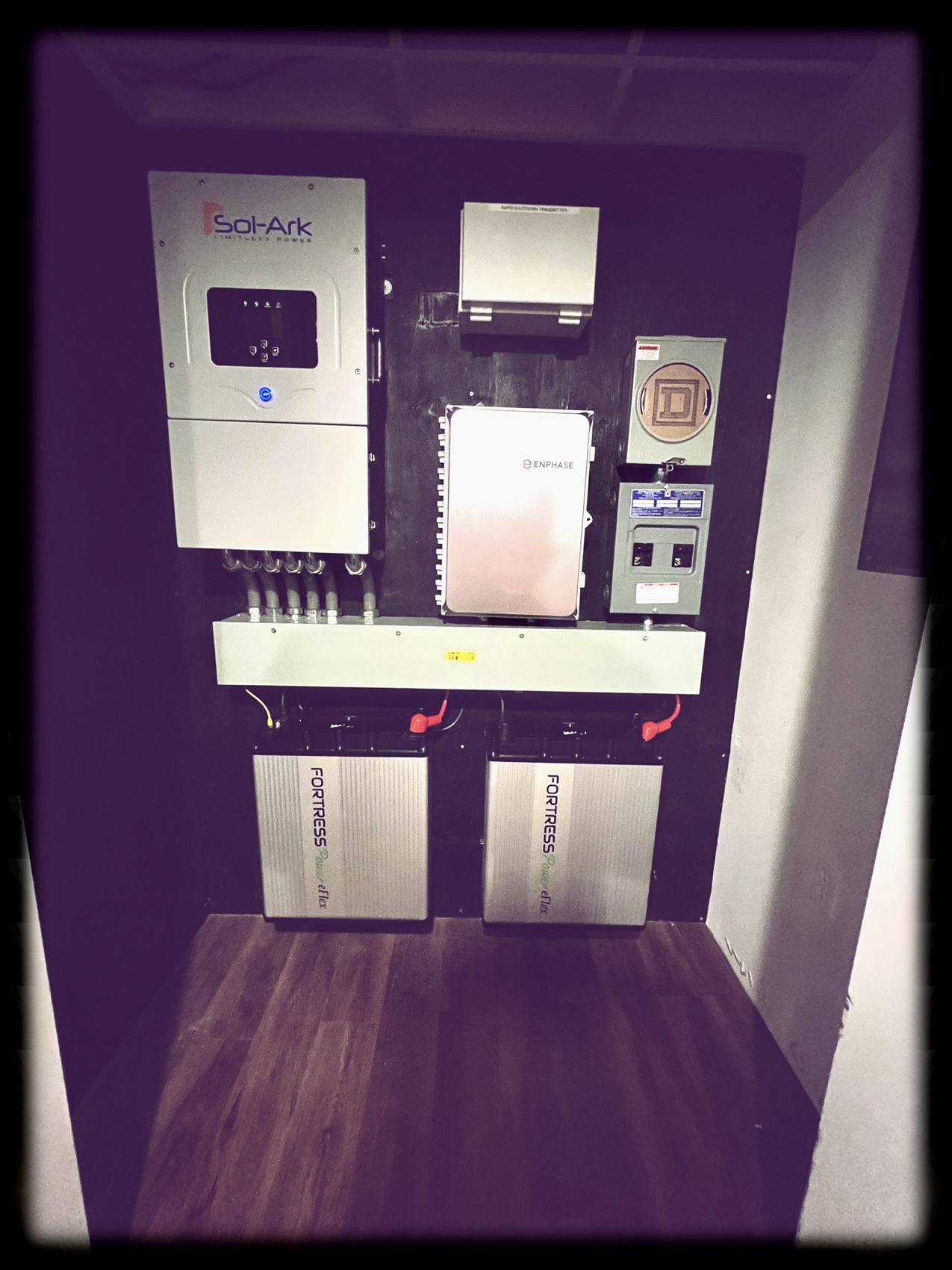
The inverter choice follows the interconnection, not the other way around. If the design is a straightforward load-side tie with no battery, an SMA or SolarEdge string setup with APsmart rapid shutdown devices keeps the electrical side simple. If backup is the point, a Sol-Ark or EG4 hybrid with a protected loads subpanel usually wins, because the panel work becomes the design: we move the circuits you actually want during an outage into a backed-up bus and leave the electric range and the hot tub on the grid side. Generac is in the mix when a homeowner wants storage and a fuel-burning standby in the same house.
We install and service EG4, Generac, Sol-Ark, SMA, SolarEdge, Tesla, APsmart, SunPower and Sungrow. If you have a Powerwall and need it worked on, that is a call we can take. More detail on the list is in our post on the equipment we install and service.
Take two photos before you talk to anybody: the breakers with the cover off, and the label inside the cover. Send them with your address and the name on your electric bill to our office and we will tell you what your panel allows. If it turns out your service needs work first, we will say that too.
The local wrinkle: PPL, the paperwork, and who inspects what
The panel decision cannot wait until the end, because the utility application is built out of it. If you are on PPL Electric Utilities, the net-metered distributed energy process asks for the application, a one-line diagram, a site plan and equipment data sheets, with an electronically signed interconnection agreement. PPL says on that page to apply at least six months before you need interconnection service, and that for installations under 25 kilowatts of inverter nameplate you should hear back within three to four weeks of a completed application. Every one of those documents describes the panel. Change the interconnection method after submission and you are refiling.
On the Pennsylvania side, net metering for a residential service is limited to a system with a nameplate capacity of not greater than 50 kilowatts under 52 Pa. Code 75.13. Most Pike County houses are nowhere near that, so the practical limit is your busbar, not the regulation.
Batteries are where the panel and the utility rules collide hardest. PPL's own energy storage interconnection policy states that energy exported from a storage system does not qualify for net metering, that exporting to the grid from the storage system is prohibited, and that the customer and contractor must use the equipment and control settings needed to prevent it. That single document is the reason a battery job in Dingman Township gets wired with a protected loads subpanel and non-export settings rather than simply parked on the main bus. We wrote up how those designs get laid out in the Poconos battery backup guide.
Who reviews the drawings depends on your municipality. Pennsylvania municipalities elected whether to enforce the Uniform Construction Code locally or leave it to the Department of Labor and Industry and third-party agencies, and DLI keeps the municipal election list and contacts on its UCC page. That is why the same drawing set can take two different paths in two townships fifteen minutes apart. We do not quote a review time or a permit fee for your township in writing, because both change and a wrong number in print becomes a phone call. We call the office that will actually handle your address. Our permit and interconnection timeline post walks through the sequence in all three states.
One budgeting note, because it comes up in this conversation constantly. The federal residential clean energy credit ended for property placed in service after December 31, 2025, and the IRS instructions for Form 5695 state that residential clean energy credits cannot be claimed for expenditures made after that date. Plan panel and service work on its own merits. It is electrical work your house either needs or does not.
Who a panel upgrade is not right for
Plainly, because the sales version of this article never says it.
- Houses with a healthy 200 amp service, room on the bus, and a modest array planned. If your label and your load calculation both say yes, we are not touching your panel. Adding a breaker is the whole electrical scope.
- Homeowners whose real problem is the roof. If the decking is soft or the shingles are near the end, the array should wait for the roof. Our sister company All In One Building LLC does that side of the work, and doing it in the right order beats doing it twice.
- Anyone who only wants outage coverage for a well pump and a freezer. That can often be a small protected loads subpanel and a battery, with no service upgrade at all.
- Renters and homeowners planning to sell inside a year or two. Service work follows the house, not you. Read our ownership and PPA comparison before signing anything long-term.
- Anyone being told a service upgrade is mandatory before the label has been read. If nobody photographed the inside of your panel cover, nobody knows yet.
What we would tell a homeowner considering this
Ask the person quoting your system what your busbar is rated for and where the solar breaker is landing. If they cannot answer both, the design is not finished. Ask which interconnection method is on the drawings, because that determines whether your meter gets touched. Ask who is submitting the utility application and who signs the interconnection agreement.
And send the photos early. A picture of your panel label costs you two minutes and can change the entire shape of the project, including whether it makes sense this year at all. If the answer is that your service needs work before any array goes up, that is worth knowing in August, not in November when the ground is hard and the schedule is tight. You can see the kinds of designs this process produces on our completed projects page, and if you want the panel read, send it over or call the office at (570) 500-2327.
Code editions, utility requirements and program rules change. Everything above was verified against the linked primary sources on the date of this post. Requirements for your address are determined by your authority having jurisdiction and your utility, not by this page.
What we would tell a homeowner considering this
- The busbar rating, the main breaker size and the free spaces in your panel set the ceiling on array size more often than the roof does.
- A panel that is full is not automatically a panel that needs replacing. There are four or five other ways to land the interconnection.
- Batteries change the panel work more than panels do, because backup means separating the loads you want to keep.
- If you are on PPL, the utility paperwork starts with a one-line diagram of that panel, so the panel decision comes first, not last.
- The federal residential clean energy credit is gone for systems placed in service after the end of 2025, so budget the electrical work as electrical work.