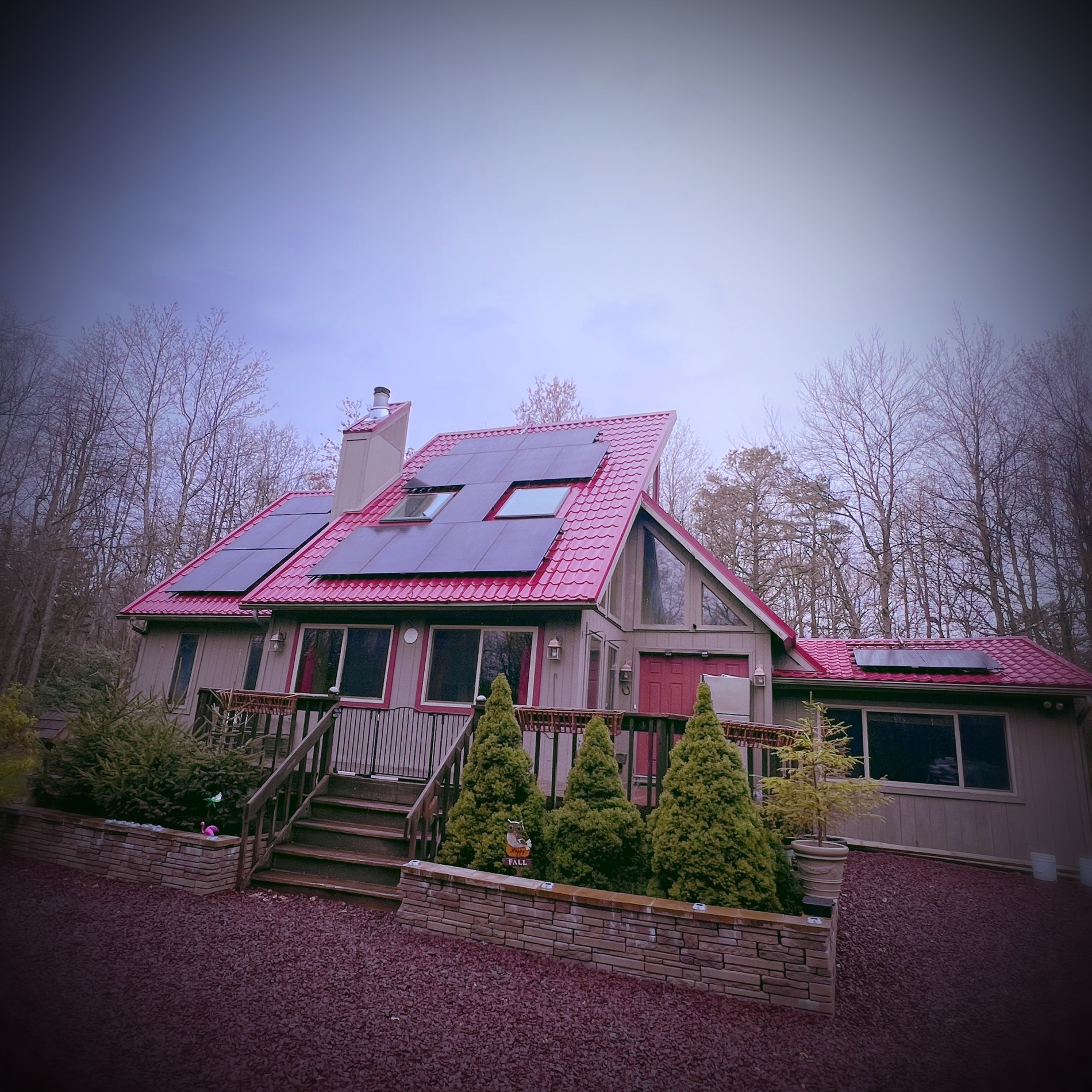
Tree shade does not kill solar in the Poconos, but it changes what the system can be and it changes whether it is worth building at all. A shadow across one module can hold back every module wired in series with it. Module-level electronics and careful string grouping contain that loss. They do not replace the sun. On a wooded lot the design question is not which panel is best. It is which parts of your roof see open sky in December, and what you are willing to do about the parts that do not.
What one shadow actually does to a string
Modules in a string are wired in series, so the current that flows through the string is limited by the weakest module in it. A branch shadow across the bottom row of one module does not politely subtract that module's share. Without help, it pulls the operating point of the whole string down toward whatever the shaded module can pass.
Manufacturers build bypass diodes into the module for exactly this reason. When a section of cells goes dark enough, the diode routes current around that section instead of forcing it through. That saves the string from the worst case. It also means the loss comes in chunks. A shadow that covers one narrow band of cells can knock out a whole section of the module, which is why a thin shadow from a wire or a bare branch is often worse than people expect and a fat soft shadow from a distant treetop is often better than they fear.
Two practical consequences follow from that, and both of them are design decisions rather than equipment decisions:
- Modules that see the same sky should be wired together. Grouping the shaded row separately from the clear row keeps one problem from becoming everyone's problem.
- Landscape versus portrait orientation matters when the shadow is a horizontal band, because it decides how many cell sections the band crosses.
Why the loss never looks like the shadow
Homeowners look up at noon in July, see sun on the whole roof, and assume the site is clear. The array does not live in July. The December sun runs low across the southern sky, and the same treeline that sits harmlessly below the array in summer lies right across it at the exact hours the array would be producing.
This is also why an estimate built from an aerial photo is close to worthless on a wooded lot. NREL's own PVWatts calculator, the tool half the industry quotes from, says plainly on its site that the array area estimate does not account for shading, and that a shading loss percentage has to come from a separate shade analysis of nearby objects (NREL PVWatts). Anybody who hands you a production number for a wooded Pike County lot without having measured the skyline from the roof plane is showing you arithmetic, not a forecast.
What a real measurement gives you is a month by month picture of solar access at each part of the array. That is the document that tells you whether the north plane is a waste of racking, whether the garage roof beats the house roof, and whether a spring trim moves the number enough to care.
Module-level electronics change the shape of the loss, not the physics
There are three different things that get sold under the same general heading, and they are not interchangeable.
DC optimizers sit under each module and let that module run at its own best operating point, so a shaded module stops limiting its neighbors. SolarEdge is the common one here. You also get per-module monitoring, which on a wooded lot is worth as much as the production it saves, because a year later the graph tells you whether the problem is the module under the maple or the inverter.
Rapid shutdown devices are a different animal. APsmart transmitters and similar hardware shut the array down at the module for first responder safety. They do not optimize anything. A system can be fully code compliant for shutdown and still lose everything shade takes, and the confusion between the two is common enough that we check it any time somebody tells us their existing array already handles trees.
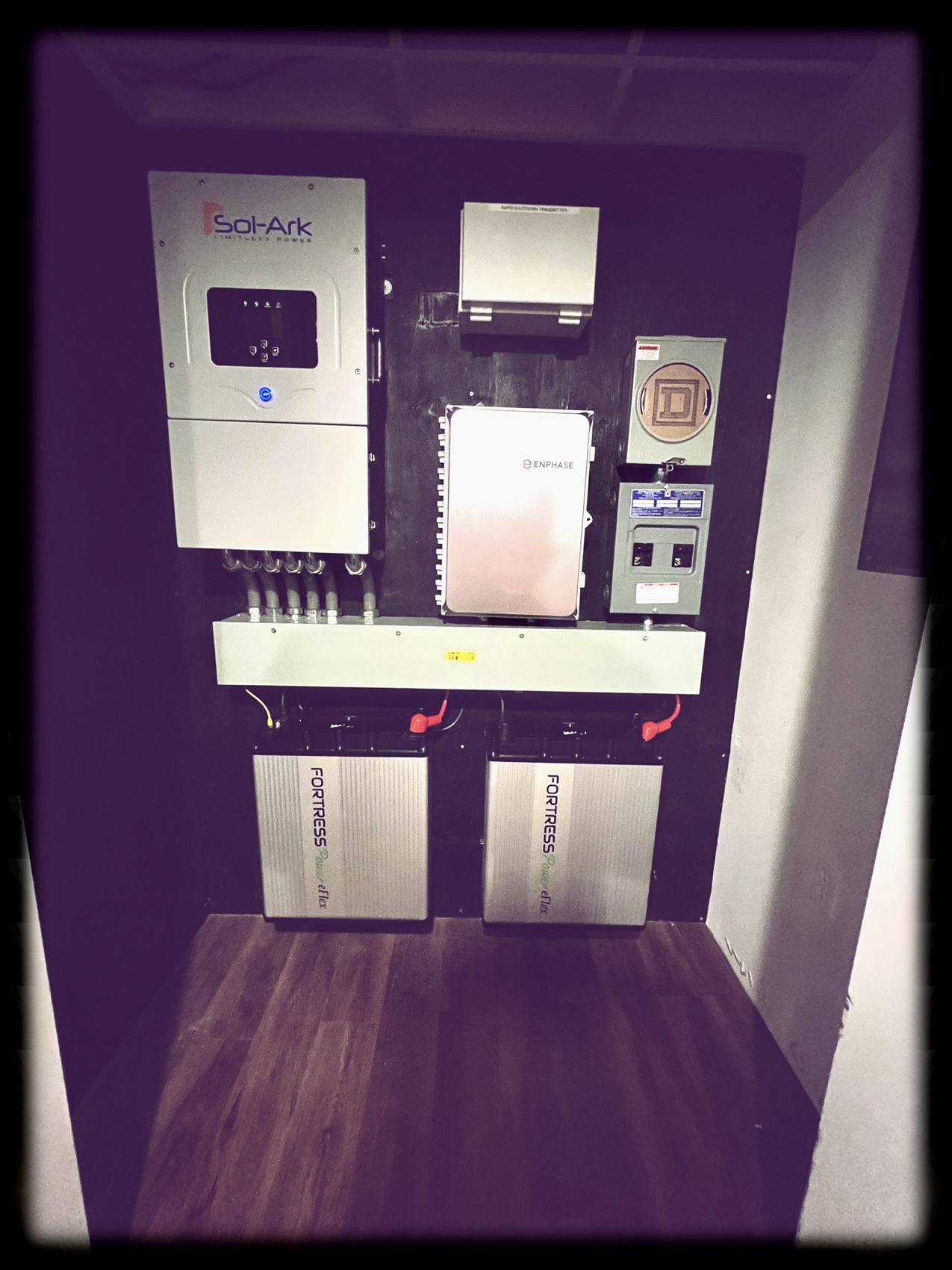
Multiple MPPT inputs on a string inverter are the cheap and often underused lever. A Sol-Ark, an SMA, or a Sungrow inverter with separate maximum power point trackers lets you run the clear south plane and the compromised west plane as independent strings. On a roof with two clean shade zones and no wandering shadows, that can be all you need.
| Approach | What it does under shade | Per-module data | Where we use it |
|---|---|---|---|
| Plain string, no module-level power electronics | Shaded module limits the whole series string, bypass diodes only cap the worst case | No | Open ground mounts and genuinely clear roofs |
| String inverter with multiple MPPTs | Isolates whole planes or zones from each other, not module from module | No | Roofs with two or three distinct, stable shade zones |
| DC optimizers under each module | Keeps one shaded module from limiting the rest of the string | Yes | Most wooded lots in Pike, Monroe and Sussex County |
| Rapid shutdown transmitters only | Nothing for production, this is a safety function | No | Where the code requires shutdown and the array has no mismatch problem |
We install EG4, Generac, Sol-Ark, SMA, SolarEdge, Tesla, APsmart, SunPower and Sungrow, and the choice on a shaded roof is driven by the shade report and the panel, not by what we happen to have on the truck. The rundown of the equipment we install and service has the full list.
Send the property address and a photo of the south side of the house taken from the yard. Tell us which utility bills you. We will tell you whether the trees make this a site visit or a polite no. Start with the address
Trees grow, and the design has to assume it
A red maple that clears the array today does not clear it in ten years. This is the part most proposals skip. When we lay out a wooded lot we look at the treeline you have and the treeline you are going to have, and then we say out loud which of those two we designed for.
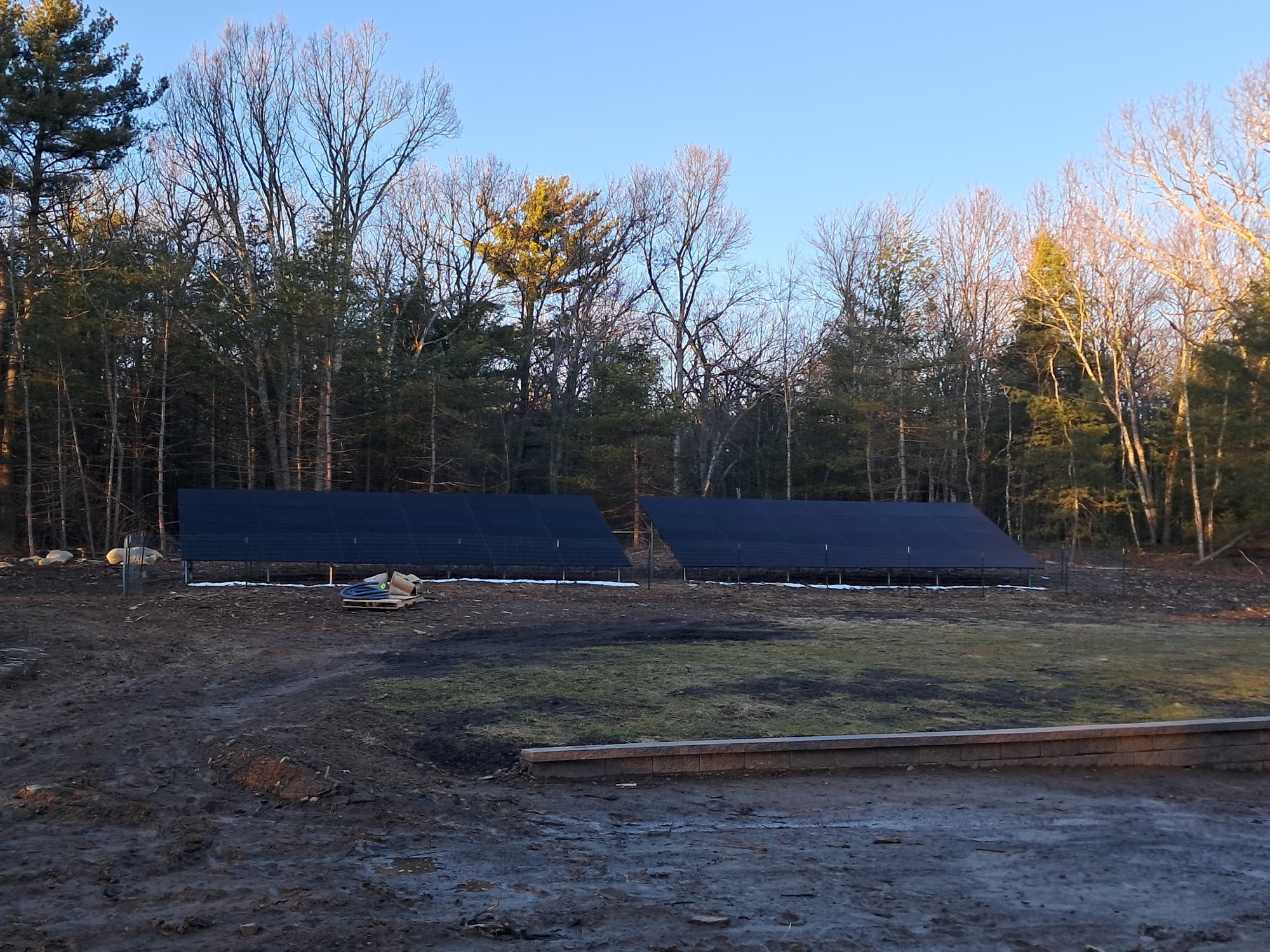
There are only three honest responses to a growing treeline. You commit to keeping specific trees topped or removed on a schedule. You accept a declining production curve and design the system knowing it. Or you move the array off the roof entirely and out to the open part of the property. All three are fine. Pretending the treeline is static is not.
Neighbor trees are their own conversation, and it is a legal one rather than an electrical one. We will show you which trees on which property line matter. We will not tell you what your rights are, because that is a question for a lawyer in your county.
The local wrinkle: shade changes the paperwork too
A shaded design is usually a smaller design, and a smaller design runs into different constraints than a big one. Two worth knowing about in this corner of the map.
First, sizing. Pennsylvania's net metering framework sets a maximum nameplate capacity for residential customer generators of 50 kilowatts under the Alternative Energy Portfolio Standards Act (Pennsylvania Bulletin). No shaded roof in Milford Township is anywhere near that ceiling. The binding constraint on your property is sunlight and roof area, not the rule, and any conversation about oversizing to make up for shade runs out of roof long before it runs out of regulation.
Second, code. Rapid shutdown requirements come from the National Electrical Code, and which edition applies to your job depends on what your state and your local code official have adopted. Pennsylvania's Uniform Construction Code moved to the 2018 I-Code series, with the revised regulations effective February 14, 2022 (PA Department of Labor and Industry). New York and New Jersey are on their own adoption cycles. Whoever is doing your plan review will tell you which edition they are enforcing, and it is a fair question to ask before the drawings are made.
Which utility serves your address is decided by the address, not by the township name, so we check it rather than assume it. If you want the sequence of permit, interconnection application, inspection and permission to operate laid out end to end, that is in the permit and interconnection timeline for PA, NY and NJ. The other thing worth checking early is the service panel, because a shaded array is often small enough to change what the interconnection needs, which we cover in the piece on how the main service panel drives the design.
Who this is not right for
We would rather say this in August than have you find it out in January.
- The deep hollow lot. If the ridge to your south blocks the low winter sun before the trees even get a vote, module-level electronics are irrelevant. Terrain shade is not something equipment fixes.
- The homeowner who wants the bill covered. On a heavily wooded lot with one usable roof plane, the array that fits does not cover a whole house. If covering the whole bill is the only outcome you will accept, and the trees are staying, this is not your project.
- Anyone counting on the old federal incentive. The residential clean energy credit is not available for expenditures made after December 31, 2025 (IRS Form 5695 instructions). A marginal shaded roof used to have that cushion. It does not now, and we will not pretend otherwise.
- Short holds. If the house is going on the market in a couple of years, spend the money on the roof instead. That one we can actually help with through our sister company, All In One Building LLC.
- Roofs that need work first. We will not put racking on decking that needs replacing. Roof first, array second, always.
Turning someone down is not a sales tactic. It is a maintenance decision. Every array we build on a bad site becomes a service call and a bad review three winters later, and we live here.
What we would tell a homeowner considering this
Start with the measurement. Everything else in this post is theory until somebody stands at the array plane and reads the skyline. That visit is where you find out whether you have a solar site with a tree problem or a tree site with a solar fantasy.
Then ask the design questions in this order. Which planes have usable winter access. Whether string grouping alone handles the shade or the site needs optimizers under every module. Whether the open ground beats the roof. Whether any tree work you were already planning changes the answer. Whether the panel and the service entrance can take the interconnection.
If storage is part of what you want, read the battery backup guide for the Poconos first, because a battery on a shaded array behaves differently than a battery on a clear one and the sizing conversation is not the same. If you are being pitched a lease or a power purchase agreement on a shaded roof, the ownership versus PPA comparison is worth twenty minutes, since a production-based contract on a marginal site is a different risk than it is on an open field.
You can see the range of what we have built around here on the completed projects page, and the full list of what we do, including roofing and HVAC, is on the services page. When you are ready, send the address and the utility name to the office at (570) 500-2327 or through the contact form, and we will start with the trees.
What we would tell a homeowner considering this
- One shaded module does not cost you one module's worth of production on a plain string. It can hold back everything wired in series with it.
- Module-level electronics limit the damage and tell you where the damage is. They do not create sunlight.
- The only shade number worth designing to comes from a measurement taken at the array plane, not from a satellite photo.
- On some wooded lots the honest answer is a ground mount in the field, and on some it is no.
- The federal residential clean energy credit is over for expenditures made after December 31, 2025, so a marginal shaded roof has less room to hide.