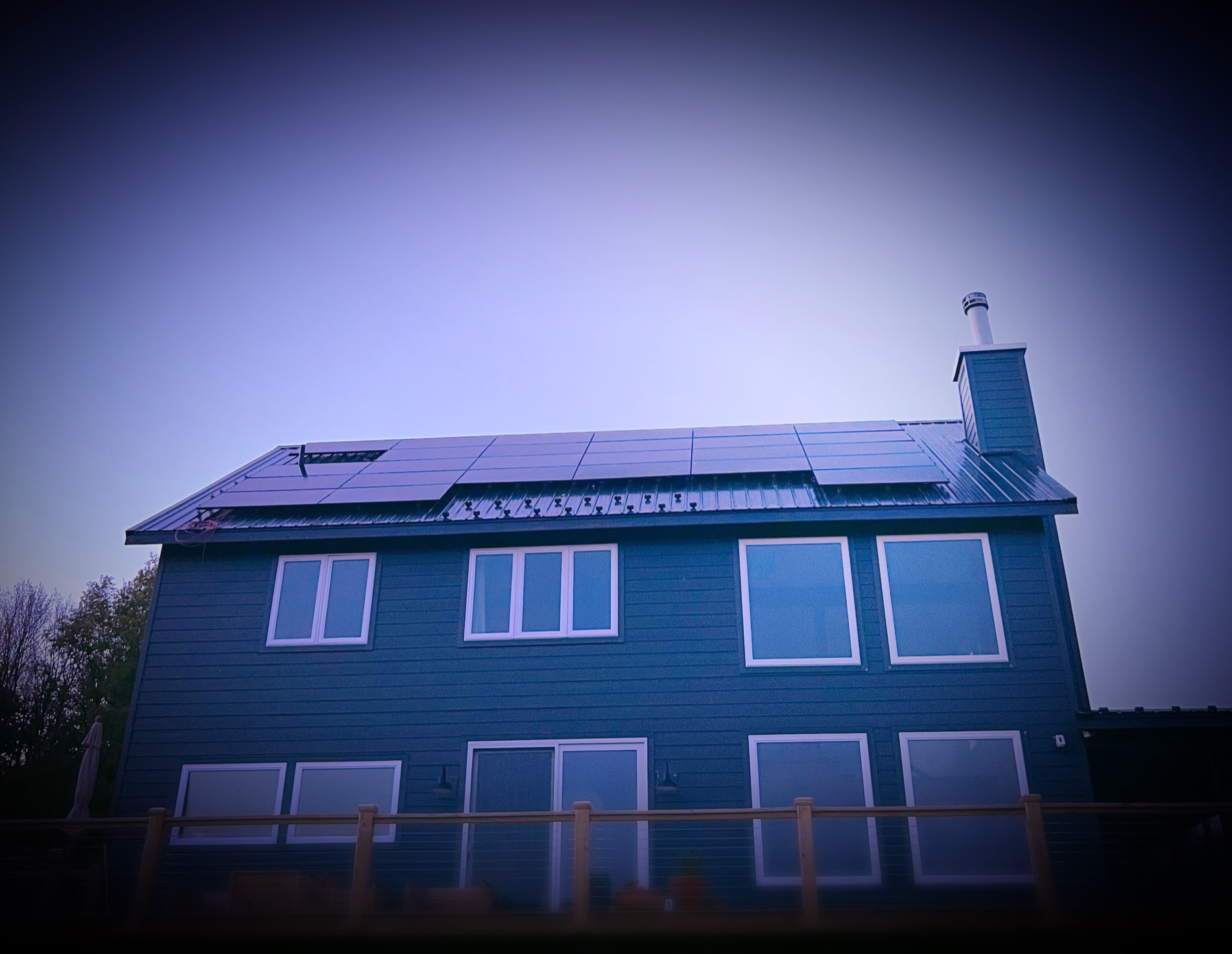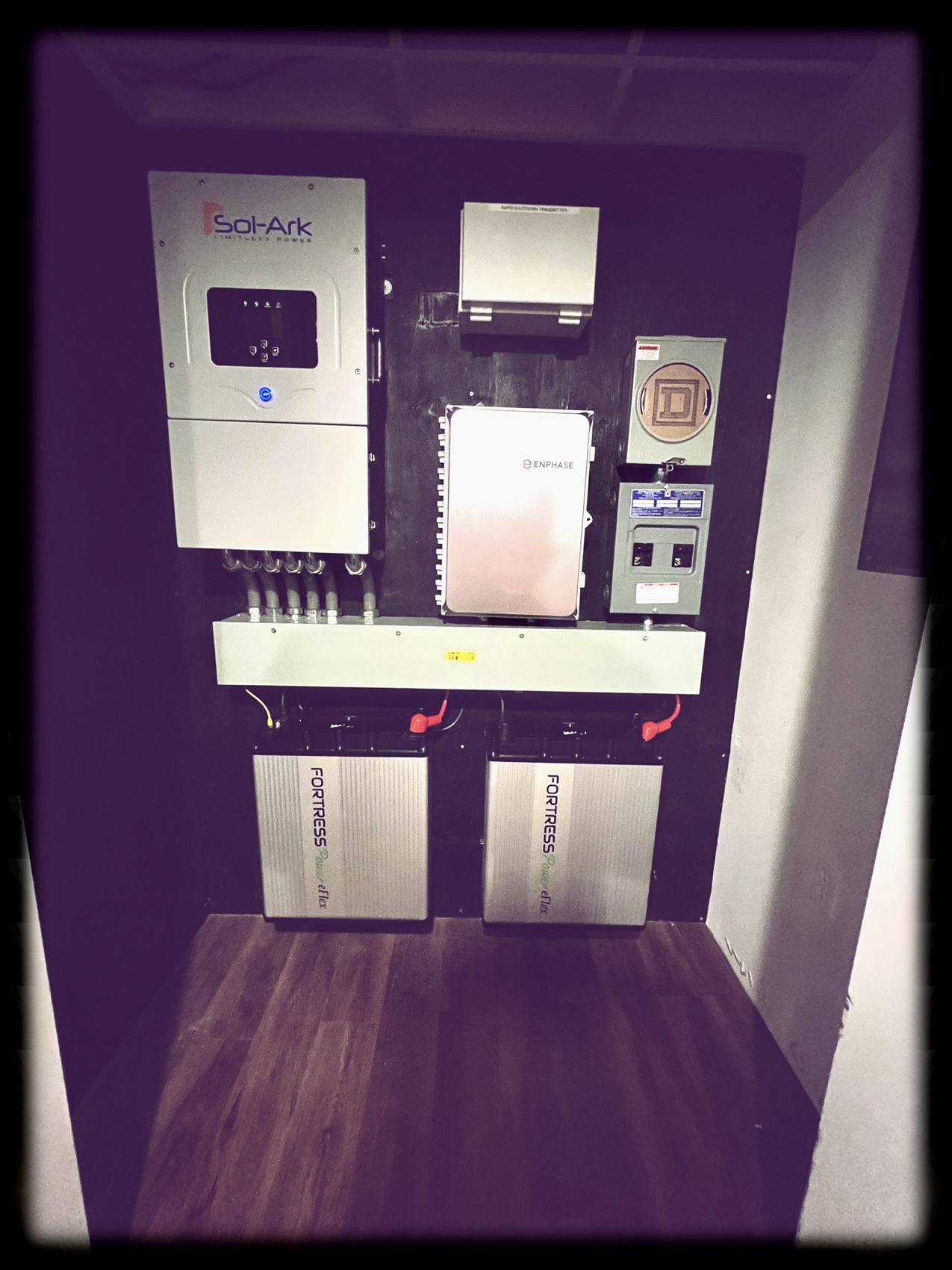
If your power goes out for a few hours several times a year, a home battery usually covers it. If your power goes out for days in February, with a well pump and a heat pump hanging off the panel, a standby generator is usually the better answer and sometimes the only one. A battery runs on stored energy and refills from solar or the grid. A generator runs on fuel you buy and store. The honest version, for a lot of houses on this side of the Delaware, is that the two do different jobs.
What each one actually does when the lights go out
A home battery is a box of stored electricity with an inverter and an automatic transfer device. When the utility drops, it disconnects your house from the grid and keeps your chosen circuits alive. The switchover is fast enough that most people notice it only because the well pump hiccups. Nothing starts, nothing warms up, nothing burns. If you have solar, the battery recharges during the day and you can ride out a long outage in a loop: charge in the sun, spend overnight, repeat.
A standby generator is an engine and an alternator sitting on a pad outside, wired to an automatic transfer switch. When the utility drops, it waits a few seconds to be sure, cranks, warms, and takes the house. It will run as long as you feed it. That is the whole argument for a generator in one sentence.
The comparison, attribute by attribute
| Home battery | Standby generator | |
|---|---|---|
| Energy source | Stored electricity, recharged from solar or the grid | Propane or natural gas you buy and store |
| Run time | Hours to a couple of days on the backed-up loads, longer with solar recharging | As long as the fuel holds |
| Sound during an outage | Silent | An engine running outside your house, on and off, for the duration |
| Routine maintenance | Firmware and an annual look at terminals and ventilation | Oil, filters, plugs, battery, and a weekly self-exercise cycle |
| Useful when the grid is up | Yes, it can shift when you draw from the utility | No, it sits idle and exercises |
| Cold weather | Needs a reasonable location and a rated temperature range | Starts in the cold if it is maintained and the fuel supply is sized right |
| Big motor loads | Depends on the inverter, needs design attention | Generally the easier answer for a deep well or a large air handler |
| Siting | Indoors or on a protected wall, close to the panel | Outdoors on a pad with clearances and a fuel line |
| What fails | Electronics, communications, the breaker coordination | Anything an engine fails at, usually because nobody serviced it |
Fuel is the part people get wrong
A generator does not run on good intentions. It runs on propane or natural gas, and in most of Pike County that means propane in a tank in your yard, because there is no gas main at the end of your road. Generac's home standby line is built for both fuels, and the manufacturer publishes which units run on natural gas and which on liquid propane.
So the question is not "how long will it run", it is "how big is your tank and who fills it". A multi-day outage after a wind event is exactly when the propane truck is also trying to get down everybody's unplowed driveway. If you own a small tank, a generator gives you fewer days of comfort than the brochure implies. If you own or lease a large tank and keep it topped before winter, a generator is close to unlimited.
A battery has the opposite shape. It cannot run out of deliveries, but it can run out of charge, and without solar there is no way to refill it until the grid returns. A short December day in the Poconos puts a real ceiling on what solar gives back, which is why we size backup around a critical loads panel instead of the whole house. We wrote about that in how a critical loads panel changes what a battery can carry.
Noise, neighbors and where the thing sits
A battery makes a fan noise and that is it. A standby generator is a small engine thirty feet from somebody's bedroom window. During a three-day outage it will run most of that time. It also exercises itself on a schedule, which is the sound your neighbor learns to recognize.
On a half-acre lot in Matamoras that matters more than it does on five wooded acres in Shohola. Setbacks, clearance from windows and openings, and exhaust direction come out of the manufacturer's installation instructions and your local code official, not out of a preference. The honest comparison is this: nobody has ever called us to complain about the noise a battery makes.
Maintenance is the long tail
An engine needs oil, filters, plugs and a starting battery, and it needs them on a schedule whether or not the power has gone out. Generac publishes the maintenance steps for its home standby units, and the owner's manual for your specific model is the document that governs. Skip it for four years and you will find out during the storm that the unit cranks and does not catch. That is the single most common generator failure we are called to look at.
A battery has no consumables. It has firmware, a communications path, and electrical connections that should be looked at and torqued. It will also quietly lose capacity over its life, which is normal and which the manufacturer defines in the warranty document. Ask for that document before you sign anything, and read what it says about capacity retention and about who performs service.
What we install, and what we do not touch
On the storage side we work with EG4, Sol-Ark, SolarEdge, SMA, Sungrow, APsmart and SunPower equipment, and on the generator side we install and service Generac. We do not service Tesla systems, including Powerwall. If you have one, you need an installer who does, and we will say so on the phone rather than waste your morning. The full list is in the equipment we install and what we will not service, and completed work is on our projects page.
Brand matters less than two unglamorous things: whether your main service panel has room and a bus rating for what you are adding, and whether whoever installs it picks up the phone in year six. Panel room decides more battery designs here than any spec sheet does, and we covered that in what your main service panel does to a backup design.
If you are weighing these two, send us the address, a photo of the inside of your main panel with the cover off, and the name of the utility that bills you. That is enough for us to tell you which of these makes sense at your house before anybody comes out. Start with the address and a panel photo or call the office at (570) 500-2327.
Where a Generac is simply the better answer
There are houses where we will tell you to put in the generator and stop thinking about it.
- You lose power for days, not hours. Rural Pike, Wayne and Sullivan County feeders run through a lot of trees. When a storm takes out the line into your development, restoration is measured in days, and PPL posts its progress on its storm response updates while you wait. A battery sized for a normal outage does not cover that week.
- You heat with a heat pump or you have a deep well. Big motor loads and long duty cycles eat stored energy fast.
- The house is unoccupied part of the year. A camp or a second home in Lords Valley that freezes while you are in Jersey is a plumbing bill, not an inconvenience. A generator that starts on its own and runs on a full tank protects the house whether or not anybody is there to watch the state of charge.
- You have no solar and no plan to add it, or the roof is shaded and staying that way. A battery with no recharging path is a short bridge. If the site will not produce, do not design the backup around production.
Who a battery is not right for
Being straight about this is more useful than selling you one.
- Houses where every outage is measured in days and there is no solar to recharge. You will be rationing by the second evening.
- Houses with a crowded or undersized main panel where the owner does not want to touch the panel. A battery almost always means panel work. If that is a hard no, the generator path is usually shorter.
- Houses where the backup wish list is "everything, including the electric range and both air conditioners". That is a generator conversation, or a much larger battery conversation than most people want.
- Anyone buying backup purely as a financial move. We do not publish savings math, and anybody who hands you a tidy number for a house they have not seen is selling, not estimating.
- Tesla owners looking for service on existing Powerwall equipment. We do not service Tesla systems.
The money part, and what has actually changed
The federal picture changed and you should hear it plainly. The residential clean energy credit under Section 25D is over: the IRS states the credit is not allowed for any expenditures made after December 31, 2025. If a salesperson still has it in their pitch deck, that tells you something about the rest of the deck.
State programs are where it gets local, and they are decided by address.
- New York. NYSERDA runs a residential and retail energy storage incentive that is paid through approved participating contractors rather than to you directly, and incentive levels step down in blocks as each block fills, which contractors track on NYSERDA's residential dashboard. If your house is in Orange or Sullivan County, start with what the NYSERDA battery incentive means for Orange and Sullivan County homeowners.
- New Jersey. Whether a storage program is open to residential customers, and what it requires, is set by the New Jersey Board of Public Utilities, and the BPU's own orders are where any change shows up first.
- Pennsylvania. There is no state storage incentive we can point you to today. Net metering and interconnection for customer generators are handled through the Public Utility Commission, which publishes a consumer FAQ on solar systems.
Note what is missing: we cannot point you to any incentive for a generator anywhere in our footprint. That is not an argument against one, it is just the ground truth.
Permits, inspection and the utility
Both paths need a permit and an inspection. In Pennsylvania residential work is administered under the Uniform Construction Code, and the administrative rules municipalities follow are in 34 Pa. Code Chapter 403. Which office actually issues the permit depends on your township, so we confirm it per address rather than assuming.
The paperwork paths are not the same length. A battery tied to solar also goes through your utility's interconnection process and ends with permission to operate, which we walked through in the interconnection letter and what permission to operate means. A transfer-switched generator is mostly a local permit, an electrical inspection and a fuel connection. Ask us which one applies before you plan around a date.
One safety note that costs nothing: if your current plan is a portable unit and an extension cord, read the PUC's portable generator safety fact sheet before the next storm. Backfeeding a house without a transfer switch is how linemen get hurt.
What we would tell you if you called this week
Most people who call about this have already decided based on their last bad week. That is reasonable. The useful questions are narrower than battery versus generator. How long are your outages, honestly, over the last five years. What has to stay on and what can go dark. Is anybody at the house to manage it. Does the panel have room. How big is the tank in the yard.
Answer those five and the equipment choice mostly makes itself. Plenty of houses here end up with a generator for the long winter outages and a battery later for the grid-up work, and that order is usually the right one when outages are the problem you are solving. Our services page covers both, and the office is the fastest way to get an answer about your address.
Questions we get asked
Can a battery run my well pump?
Often yes, but it depends on the pump and the inverter. A deep well with a big starting draw needs the design checked, not assumed. Send us the pump's nameplate data and we will tell you.
Will a Generac run on my existing propane tank?
Maybe. It depends on the tank size, the vaporization rate in cold weather and the regulator, which is why the fuel supply gets sized as part of the install rather than after it. Your propane supplier has to be part of that conversation.
Can I have both?
Yes, and it is common here. The design question is how the transfer equipment and the battery inverter are coordinated so they are not fighting each other, and it is easier if both are planned at once rather than bolted together years apart.
Do I need solar for a battery to be worth installing?
No, but without solar the battery is a fixed amount of energy with no way to refill until the utility returns. For short outages that is fine. For multi-day outages it is not, and we will say so.
Does a generator help with my electric bill?
No. It sits idle until the power fails. A battery can shift when you pull from the grid, which matters more as rates move. We walked through what has been happening to local bills in the 2026 electric bill increase explained.
Do you service Tesla Powerwall?
No. Solar Bear does not service Tesla systems. We will tell you that on the first call so you can find someone who does.
What we would tell a homeowner considering this
- A battery is quiet, maintenance-light and useful every day, but it runs out unless solar or the grid refills it.
- A standby generator runs as long as the fuel holds, which is why it wins multi-day winter outages in rural Pike, Wayne and Sullivan County.
- An engine needs oil, filters and a starting battery on the manufacturer's schedule. Skipped service is the most common reason a generator fails during a storm.
- The federal residential clean energy credit under Section 25D is gone for expenditures made after December 31, 2025, and no incentive we can source applies to generators.
- Solar Bear does not service Tesla systems, including Powerwall.