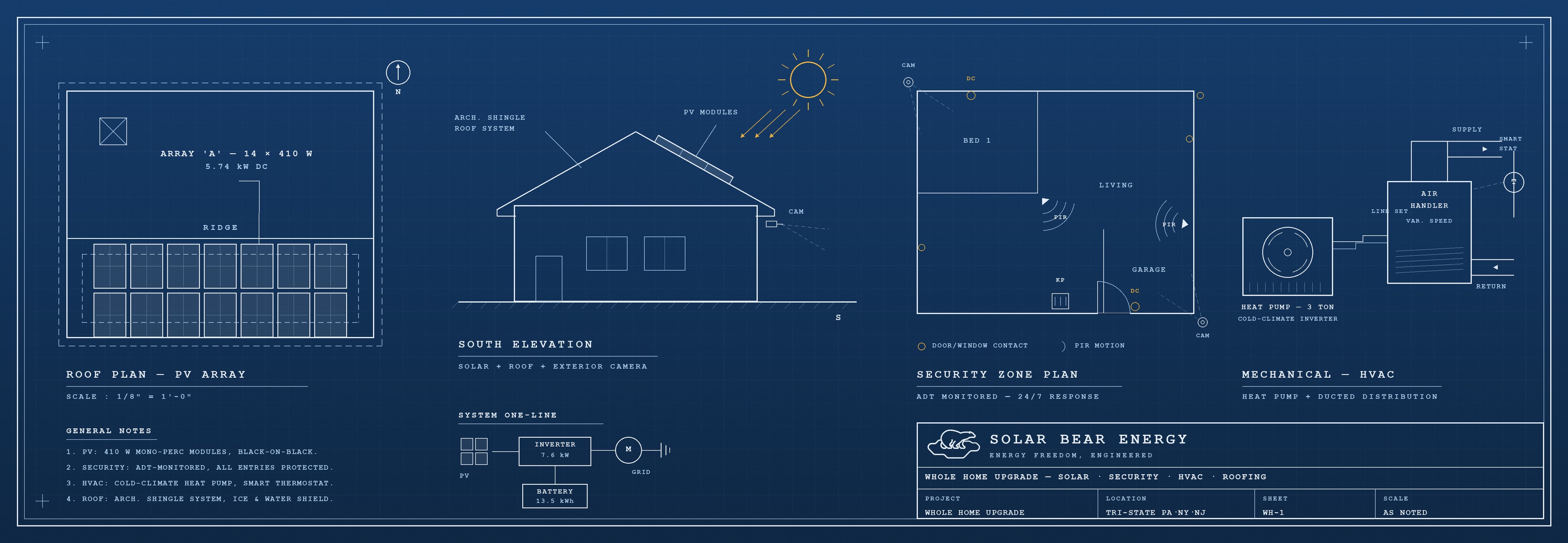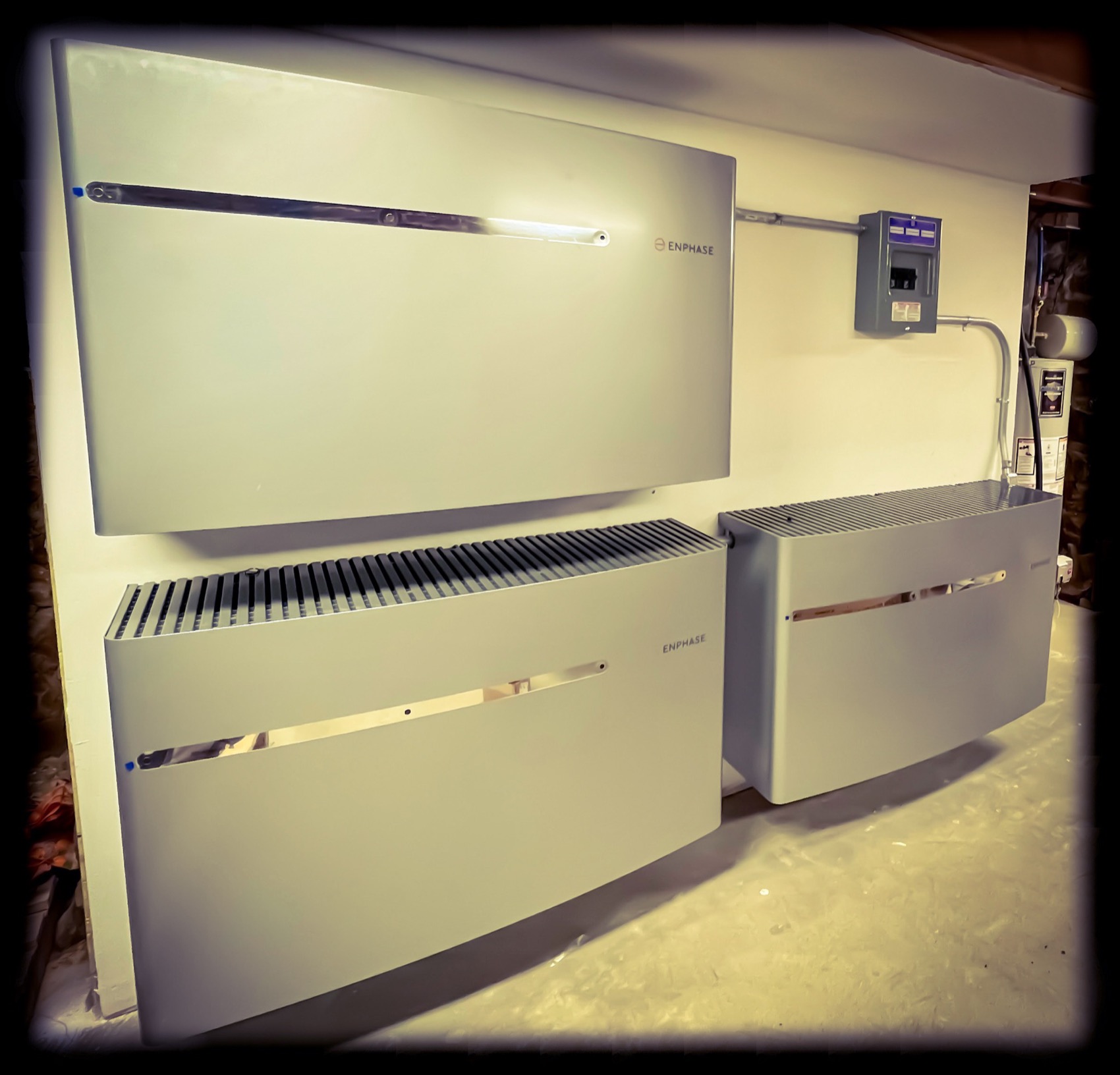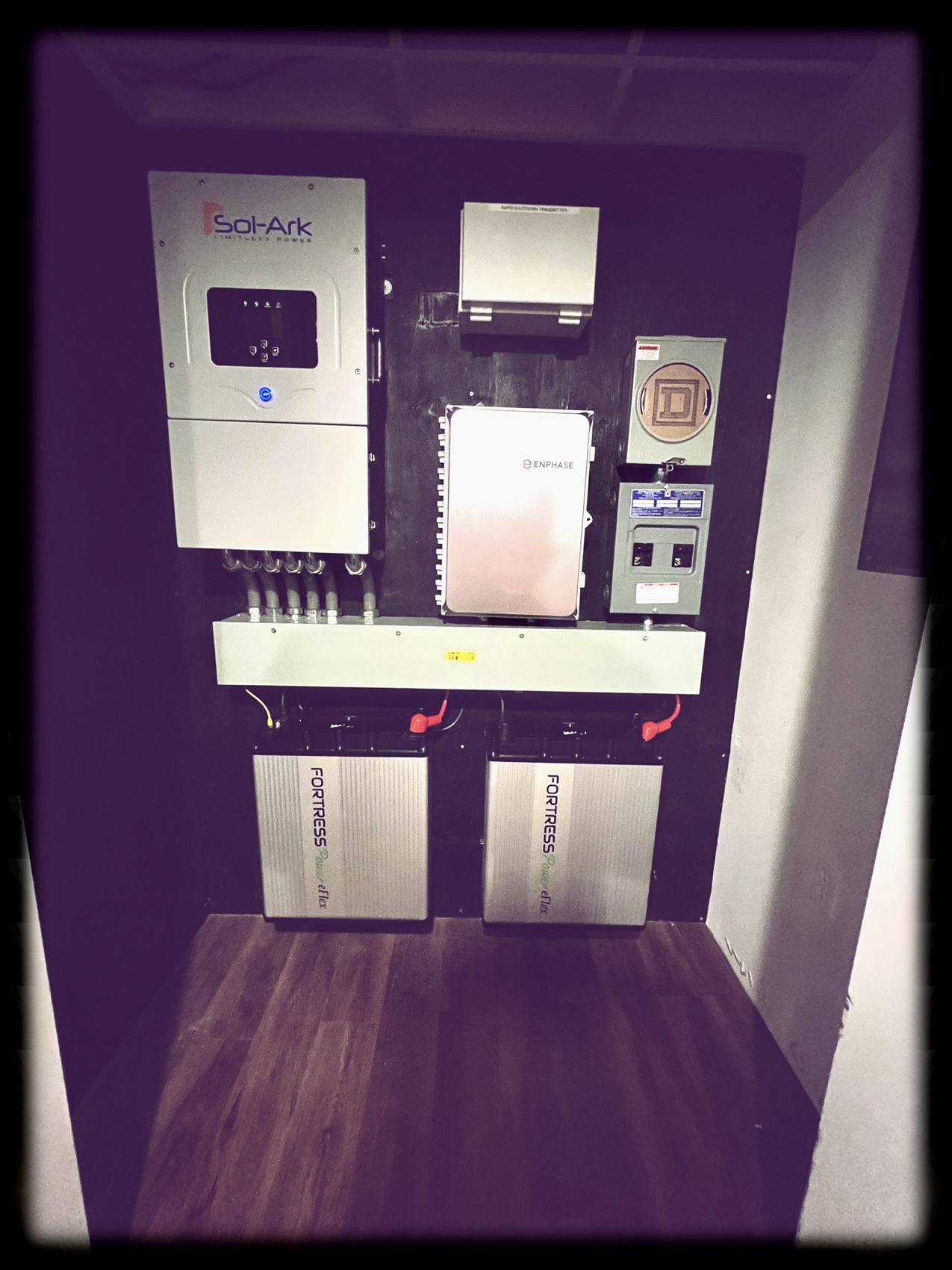
Start from the loads that keep your house habitable on a January night, then size the battery to that list. In this corner of Pennsylvania, New York and New Jersey that usually means the well pump, the heating controls and the blower or circulators, the refrigerator and the chest freezer, the septic pump if you have one, the internet gear, and a modest set of lights and outlets. The electric range, the dryer, the water heater and the car charger normally stay off the backup side. The circuit list drives the equipment. Not the other way around.
Why the load list comes before the battery size
The usual order is backwards. Somebody writes a kilowatt-hour number on a quote, and the circuits get sorted out later, on install day, by whoever is standing at the panel with a flashlight. That is how a homeowner ends up with a backed-up television and a dead well.
Two different numbers decide whether backup power feels like anything at all. The first is instantaneous power: what the inverter can deliver at the moment a 240-volt submersible pump starts. The second is energy: how much the house draws over the hours or days the line is down. A large battery behind an undersized inverter still will not start your pump. A right-sized inverter with a small battery will start it and then run out at three in the morning. Both numbers come out of the circuit list, and neither comes out of a round number somebody wrote down first.
There is a code dimension to this too. Under the National Electrical Code rules for optional standby systems, a system with automatic transfer either has to be able to supply the full connected load or has to use an energy management system to keep the load inside what the source can carry, as North Carolina's Office of State Fire Marshal summarizes for 702.4(A)(2). In plain terms: you either limit what is connected, or you install controls that limit it for you. "We will just be careful during an outage" is not one of the options.
The five loads that make a house livable here
Rank them in this order and the rest of the design gets easier.
Water. If you are on a private well, no pump means no drinking water, no shower and no toilet. On most rural properties in Pike, Sussex and Orange County this is the single most important backed-up circuit, and it is almost always a dedicated 240-volt breaker feeding a control box.
Heat. Oil and propane systems need very little electricity, but they need it absolutely. The burner, the control board, the circulators or the furnace blower, and the thermostat all sit on ordinary 120-volt circuits. Back those up and a cold-weather outage becomes boring instead of dangerous. Whole-house electric baseboard heat is a different conversation, and usually a losing one for a battery.
Food. The kitchen refrigerator and the chest freezer in the basement. These cycle, so they are gentle on a battery, and they are the loads people regret skipping.
Waste. If your septic system has a pump tank, a mound, or a grinder pump, that circuit belongs on the list. Houses on gravity systems can skip it.
Information. The router, the fiber or cable terminal, and the cell booster if the house has one. Your own gear is only half of the picture, because the provider's equipment down the road has its own power situation, but a dead router is a self-inflicted problem.
Then the short list of specifics that are personal to the house: a sump pump in a wet basement, a medical device like a CPAP or a medication refrigerator, the garage door opener when the garage is the only practical exit, and enough lighting and receptacle circuits to live in the kitchen and one bedroom. If anyone in the house depends on a powered medical device, say so during design, and keep a plan that does not depend on any single piece of equipment staying online.
What usually stays off the backup side
The electric range, the clothes dryer, the electric water heater, the hot tub, the pool pump, the EV charger and central air conditioning. None of these are impossible. They are expensive in capacity, and in a long outage they are the loads that quietly drain the battery while you sleep. A propane cooktop or a camp stove covers dinner. A cold shower is survivable. A frozen well line is not.
Heat pumps sit in between. A modern inverter-driven mini split is a reasonable backup load. A conventional air handler with electric resistance strips is not, unless the strips are locked out during backup, and that needs to be designed in rather than assumed.
Three ways to wire it
| Approach | What has power in an outage | Install day work | Where it gets difficult |
|---|---|---|---|
| Critical loads subpanel | Only the circuits you chose, fed from a new subpanel beside the inverter | Trace, move and relabel each selected branch circuit into the new panel | Every future change is a service call. Long circuit runs sometimes need splicing or a junction box |
| Whole-home backup with load management | Everything in the main panel, with the large loads shed automatically when the battery is carrying the house | Transfer equipment ahead of the main panel, plus controllers or relays on the big 240-volt loads | More equipment, more commissioning, and a plan review that takes longer in some townships |
| Whole-home with the big loads moved out | Everything except the loads you deliberately relocated to a non-backed-up subpanel | New subpanel for range, dryer, charger and similar, then transfer equipment on the rest | Needs room in the service for a second subpanel, and the main panel has to be in good shape |
The first option is the most common in older Poconos and Pike County houses, because the existing panel is full and the budget for panel work is better spent on the loads that matter. The second is the better answer in a newer house with a clean 200-amp service and a homeowner who does not want to think about which outlet is which. The third is underrated, and it is often the simplest path to a house that feels normal during an outage.
If your main panel is a Federal Pacific Stab-Lok, a Zinsco, or simply full, that gets solved first. We wrote about that in what a main service panel upgrade means for a solar design.
What we install, and why it changes the circuit list
The equipment choice is downstream of the list, but the list is also constrained by what the equipment will do.
Sol-Ark hybrid inverters when we want one box handling the array, the battery and a generator input, with enough surge to start a well pump without theatrics. EG4 when the homeowner wants stacked capacity and a straightforward path to adding another battery later. Generac when the design leans on managed 240-volt loads, because the load-controlling modules let a big circuit stay connected and get shed automatically instead of being cut out of the house entirely. SolarEdge, SMA, Sungrow and APsmart show up where the existing array or the shading situation points that way. More on that in the equipment we install and what we do not service.
One thing said plainly: Solar Bear does not service Tesla systems. If you have a Powerwall, we are not the company to call for it, and we would rather tell you that now than after you have waited on a callback.
Whatever brand goes on the wall, ask for the manufacturer's written warranty terms before you sign, and read the throughput and cycle language rather than the headline number on the brochure.
Send a photo of your breaker directory. Open the main panel door, photograph the label sheet, and tell us which utility bills the house and whether you are on a well and septic. We will come back with the circuits we would back up, the ones we would leave on the utility side, and what that means for equipment. Start with your address and a panel photo or call the office at (570) 500-2327.
The local wrinkle: utilities, code officials and paperwork
Which utility bills your address, not which township you live in, decides the interconnection application, the meter work and the timeline. Across our footprint that could be PPL Electric Utilities, Met-Ed, Orange and Rockland, Central Hudson, NYSEG, Sussex Rural Electric Cooperative, JCP&L or PSE&G, and in border towns the line on the map does not follow the town line. The sequence is the same either way, and we walked through it in what the permission to operate letter actually is and permit and interconnection timelines across PA, NY and NJ.
On the Pennsylvania side the electrical work falls under the statewide Uniform Construction Code, enforced either by your municipality or by the state through a third-party agency. The practical effect on a backup design is the inspection: the critical loads panel has to be labeled so somebody who has never seen your basement can read it, and the battery disconnect has to be where a firefighter can find it. Ask your code official which edition of the NEC is in force on the day you pull the permit, because the answer changes what the inspector expects from load calculations and labeling.
Incentives are their own country. In New York, NYSERDA offers incentives for home battery storage installed through approved contractors, which matters for Orange and Sullivan County readers and is covered in our NYSERDA battery post. In New Jersey, the Board of Public Utilities released a straw proposal in August 2026 for the next phase of the Garden State Energy Storage Program, including the residential piece, so check the BPU's own newsroom for where that stands before you plan around it. And the federal residential clean energy credit is gone for property placed in service after December 31, 2025, per the IRS. We said more about that in the 2026 credit post.
Who this is not right for
Houses heated entirely with electric resistance. Baseboard or strip heat will outrun any residential battery in a cold snap. If that is your house, the honest first move is heat, not storage, and that is an HVAC conversation on our services page rather than a battery one.
Homeowners who already have a well-maintained automatic standby generator and only care about outages. A battery can still earn its place on self-consumption depending on your tariff, but if the generator starts every Tuesday and runs the whole house, resilience is already handled.
Anyone planning to sell within a year or two. The circuit list is a design for how you live in the house. Build it for the next owner's habits and it will fit nobody.
Houses where the service equipment is at the end of its life. Panel first, battery second. Doing it in the other order means paying twice for the same labor.
Anyone who wants everything backed up, including the hot tub and the car. That is a generator conversation, or a much larger system than most houses here need. We would rather tell you that at the kitchen table than discover it during commissioning.
How to build your list this week
Open the panel door and photograph the directory. Walk the house with a helper and have them shout when a breaker kills something, then correct the labels, because the ones written in 1994 are wrong. Write the nameplate data off the well pump control box, the boiler and the septic control panel. Note which circuits serve the bedroom you would actually sleep in during a February outage. If your utility gives you interval data, download a week of it.
Then send us the list. We will tell you what fits, what is marginal, and what we would leave out. You can see completed systems on our projects page, and if you want the broader picture of how batteries behave in a Poconos winter, start with our battery backup guide.
What we would tell a homeowner considering this
- Write the circuit list before anyone writes a battery size. The list decides the equipment.
- Water, heat, food, waste and information are the five loads that make a house livable here. Everything else is a preference.
- Starting surge, not running watts, is what trips up well pumps and compressors on backup power.
- Moving a circuit onto the backup side later is a service call and sometimes another inspection, so decide up front.
- Which utility bills your address, not which township you live in, decides the interconnection paperwork.