
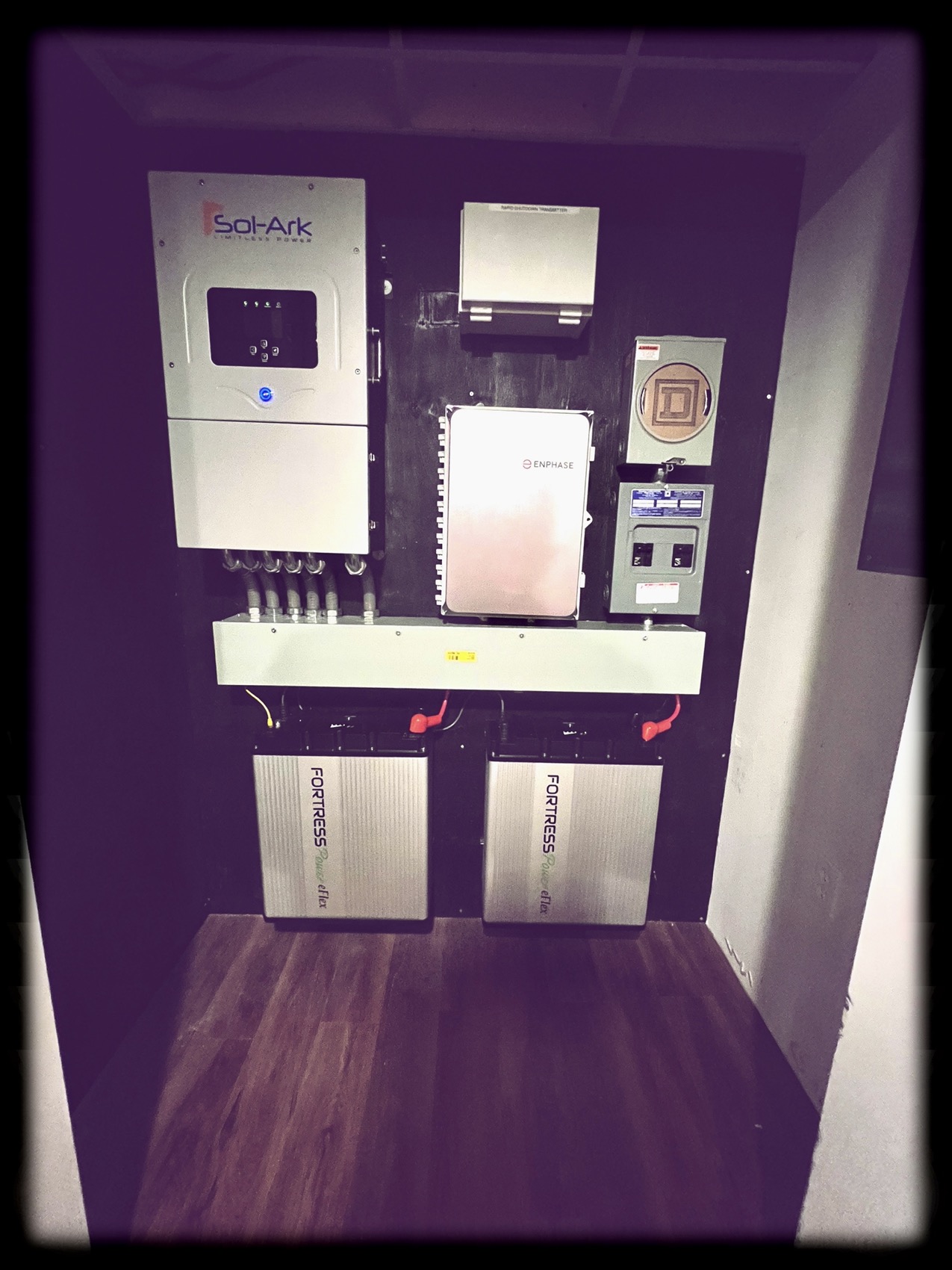
Usually you can, and in this corner of PA, NY and NJ we do it often. There are two routes. We AC couple a battery and its own inverter alongside the array you already have, or we pull the existing string inverter off the wall and put a hybrid inverter in its place. Which one fits depends on the brand and age of the inverter you own, how much room is left in your main panel, and what your utility wants on the interconnection application.
What a battery retrofit actually involves
Your array does not change. The modules stay where they are, the racking stays, the conduit mostly stays. What changes is everything between the inverter and the meter.
A retrofit is four separate problems. The battery needs a place to live that stays within its listed temperature range. It needs a way to charge, which is where AC coupling and hybrid swaps part company. It needs a way to feed the circuits you actually care about during an outage, which almost always means a backup load panel and a transfer device. And it needs a paperwork trail, because adding storage to a system that already has permission to operate is not always a silent change in your utility's records.
Most of the retrofits we look at in Dingman Township, Bushkill and Sparrowbush are five to twelve years old. That age range matters. An inverter installed in the last few years usually has a documented AC coupling path or a hybrid sibling from the same manufacturer. An inverter from a company that no longer exists has neither, and the honest answer there is often a full inverter replacement rather than a clever workaround.
AC coupling or a hybrid inverter swap
AC coupling leaves your existing grid tie inverter in place. We add a separate battery inverter downstream of it. When the grid is up, the two work independently. When the grid drops, the battery inverter forms its own small grid inside your house, the old inverter sees that voltage and restarts, and your array keeps producing into the backup loads. Charge control happens by frequency shifting, which is how the battery inverter tells the old inverter to back off once the battery is full.
The catch with AC coupling is that the old inverter has to cooperate. Some older units respond poorly to frequency shift, some have no documented behavior for it at all, and some are simply too large for the battery inverter to absorb on a sunny day with no load. We check the actual model and firmware before we promise anything.
A hybrid inverter swap replaces the existing inverter with one that handles PV, battery and backup in a single enclosure. The result is cleaner, the monitoring is one app instead of two, and there is one manufacturer to call when something misbehaves. The cost is that your existing strings have to land inside the new inverter's MPPT voltage window, and whatever warranty remained on the old inverter goes in the truck with it.
There is one hard fork in this decision. If your array uses microinverters, there is no DC to give a hybrid inverter, so AC coupling is the only route. If your array uses DC optimizers, the optimizers generally expect their own manufacturer's inverter on the other end, which narrows a hybrid swap to that brand or pushes you back to AC coupling. Anyone who tells you otherwise without opening the combiner and reading the labels is guessing.
| AC coupling | Hybrid inverter swap | |
|---|---|---|
| Existing inverter | Stays, keeps running | Removed |
| Works with microinverters | Yes | No |
| Works with DC optimizers | Yes | Usually only with that brand's hybrid |
| Roof work | Rarely any | Rarely any, but strings get re-terminated |
| Enclosures on the wall | More | Fewer |
| Monitoring | Two platforms | One |
| Best fit | Newer array, inverter with warranty left, microinverters | Aging inverter, inverter already failed, string system |
What we install and why
For hybrid swaps on string systems we lean on Sol-Ark and EG4, because both handle a wide PV input range and a generator input without a pile of extra contactors, which matters on the Pike County roads where the power goes out for a day and a half. SMA and Sungrow come up on systems where the homeowner wants to keep a conventional grid tie architecture and bolt storage onto it. SolarEdge stays in the conversation when the roof is already full of SolarEdge optimizers, because that is the path that keeps module level monitoring intact. Generac shows up when the house already has a standby unit and the goal is to make the two cooperate rather than fight. APsmart handles rapid shutdown when a retrofit changes what is on the roof side.
We do not pick the box first. We pick it after we know the string configuration, the main panel rating, and where the battery can physically go. Our equipment list and the brands we do not service is public for a reason.
Send us a photo of the label on your existing inverter and a photo of your open main panel, plus the name of the utility that bills you. That is enough for us to tell you whether you are an AC coupling candidate or an inverter swap, before anyone drives out. Send the photos here or call the office at (570) 500-2327.
What makes a retrofit straightforward
Five things, in rough order of how often they decide the job.
- You own the array outright. Owned systems are simple. Leased and third party owned systems are not, because the equipment is not yours to modify. If you are not sure which you have, start with ownership versus a PPA.
- The inverter is a current or recently discontinued model. Documentation exists, firmware is available, and the manufacturer answers the phone.
- Your main service panel has room. This is the quiet deal breaker. A full panel or a marginal bus rating turns a two day job into a service upgrade, and that is a different permit and a different utility conversation. We wrote about how the main service panel shapes the design because it comes up on nearly every site visit.
- There is a sane place to mount the battery. Interior garage wall, conditioned basement, somewhere the listed temperature range holds through February. Garage versus basement is a real decision in a house that sees single digits in January, and we cover the trade offs separately.
- You know which loads you want. A battery that backs up the whole house is a bigger battery than most people want to buy. Picking circuits first is how the design stays honest, and that is what the critical loads panel does.
The local wrinkle: your utility has more say than your township
Which utility serves a house is set by the address, not by the town line, and a retrofit is where that stops being trivia. Adding storage can change how your system is classified in the utility's records even though your array has not moved.
If you are on PPL, read their own document. PPL Electric publishes an Energy Storage Interconnection Policy and Guidance that lays out the storage configurations it will accept, including standby backup during outages and parallel operation alongside existing on site generation, and it requires that a transfer switch not already on its accepted list be submitted with a specification sheet for review. That same document states that, at the time it was published, PPL Electric's tariff and the Alternative Energy Portfolio Standards Act as enforced by the Pennsylvania Public Utility Commission do not qualify storage systems for net metering. The revision we read was Revision 0, effective February 1, 2023, so confirm the current revision before you plan around it. Net metering for the solar side runs under PPL's Net Metering Rider in its filed tariff.
If you are on Met-Ed, FirstEnergy's Pennsylvania interconnection page sorts applications into Level 1 for small inverter based systems and Levels 2 through 4 for everything larger, under the Commission's net metering regulations at 52 Pa. Code 75.11 and following. Which level your retrofit lands in is a question to settle before the design is final, not after.
On the New York side, Orange and Rockland, Central Hudson and NYSEG each run their own process, and on the Jersey side JCP&L, PSE&G and Sussex Rural Electric Cooperative do the same. The sequence is the part homeowners underestimate. We covered what the approval letter means and when you are allowed to energize in our post on the permission to operate letter.
Building code review is separate from the utility. In Pennsylvania the Uniform Construction Code is adopted and amended through the Department of Labor and Industry under the Construction Code Act, which you can read about on the state's UCC regulations and statutes page. Your township enforces that code. It does not write it.
The systems we will not put a battery on
This is the section other companies leave out.
Tesla systems. Solar Bear Energy does not service Tesla systems. We will not add a battery to one, we will not interconnect to one, and we will not take the service call. If you have a Tesla array or a Powerwall, call Tesla.
Leased and third party owned arrays. If the equipment belongs to a finance company, we are not touching the AC side of it without their written sign off, and in most cases the cleanest path is a standalone battery that does not interact with the leased system at all.
Panels we would not work on in the first place. If your service equipment is an old Federal Pacific or Zinsco panel, the panel gets replaced before anything gets added to it. That is not an upsell, it is where our electricians draw the line.
Orphaned inverters. When the manufacturer is out of business, there is no firmware, no support line and no documented frequency shift behavior, an AC coupled design is a guess. We would rather replace the inverter and know what we built.
Arrays with an unsolved production problem. If the system has been underproducing and nobody has found out why, a battery hides the symptom and keeps the cause. We diagnose first. Shade is a common answer here, and the trees in the Poconos are patient.
Roofs at the end of their life. If the shingles have a few winters left, the array has to come off and go back on eventually, and doing that after a battery install is the expensive order of operations. Our sister company All In One Building LLC handles the roofing side when that is the real problem.
Incentives, and the one that is gone
The federal residential clean energy credit is over. The IRS instructions for Form 5695 state plainly that you cannot claim residential clean energy credits for expenditures made after December 31, 2025, and the same termination appears in Publication 530. If a salesperson is still building a battery proposal around that credit in late 2026, that tells you something about the proposal.
In New York, NYSERDA runs a residential energy storage incentive, and the program documents say a storage system may be standalone or interconnected with an existing form of on site generation such as PV, which is exactly what a retrofit is, and that the work must be done by an eligible participating contractor. NYSERDA's home energy storage page says the incentive covers systems up to 25 kilowatt hours, that the amount per kilowatt hour varies by region and changes over time, and that installations receiving incentives must meet the requirements in its Battery Energy Storage Guidebook. Check the current rate on NYSERDA's own dashboard rather than on anyone's sales sheet. We have a separate post on the NYSERDA battery incentive in Orange and Sullivan County.
In New Jersey, there is nothing to sign up for yet. The Board of Public Utilities announced a Straw Proposal on August 19, 2026 for Block 1 of Phase 2 of the Garden State Energy Storage Program, covering roughly 150 MW statewide with options to expand behind the meter residential storage, and the Board's stakeholder notice describes it as a proposed performance based incentive framework under Docket No. QO26040116. Proposed is not adopted. If you are in Montague or Sandyston, plan the project on its own merits and treat any future program as a bonus.
We did not find a Pennsylvania statewide residential storage rebate to point you at this week. If someone quotes you one, ask them for the state web page that says so.
What we would tell a homeowner considering this
Start with the inverter label, not the battery brochure. Nearly every retrofit decision falls out of what is already on your wall, and a five minute photo saves a wasted appointment. Then find out what your utility expects for storage, because that determines the paperwork and sometimes the design.
Be clear with yourself about what you want the battery to do. Riding out a two day outage in January is a different machine from shaving a demand peak. Both are legitimate. They are not the same purchase, and a contractor who does not ask which one you want is selling from a catalog.
If you want our read on your specific system, the services page covers what we do on the storage side, recent installs show the kind of work this looks like in the field, and the fastest start is sending us your address and your inverter model. Office line is (570) 500-2327.
What we would tell a homeowner considering this
- Two routes exist: AC couple a battery inverter alongside your array, or replace the existing inverter with a hybrid. Microinverter systems can only be AC coupled.
- The inverter label, the main panel, and a sane mounting location decide most retrofits before anyone talks about battery brands.
- Adding storage can change how your utility classifies the system, so read your utility's own storage interconnection document before the design is final.
- The federal residential clean energy credit cannot be claimed for expenditures made after December 31, 2025.
- Solar Bear Energy does not service Tesla systems, and we do not retrofit leased or third party owned arrays without the owner's written sign off.