Two separate increases landed on the same bill this year. On the supply side, Pike County Light & Power's price to compare rose 19.8 percent on June 1, 2026, the largest jump of any of Pennsylvania's nine electric distribution companies. On the delivery side, a rate settlement the state approved in August 2025 had already raised PCL&P's distribution rates. PPL customers got a much smaller supply increase plus a separate distribution increase effective July 1. Then a hot summer multiplied all of it. Only some of that is yours to move.
Your electric bill is two bills stapled together
Every Pennsylvania electric bill splits into two halves that have almost nothing to do with each other.
Supply, also called generation, is the actual electricity. It is quoted in cents per kilowatt-hour, and the utility's default rate for it is called the price to compare. You are allowed to buy this from someone else. It resets on a schedule set by the state, not by the utility's own discretion.
Delivery, also called distribution, is the poles, the wires, the transformers, the substations, the trucks, and the people. It includes a fixed monthly customer charge you pay even in a month you use nothing. You cannot shop it, switch it, or opt out of it. It changes only when the Pennsylvania Public Utility Commission decides a rate case.
Most of the confusion we hear on the phone comes from people comparing one half to the other. A neighbor's supplier offer and your utility's delivery increase are not the same animal, and a good deal on one does nothing about the other.
What actually changed for Pike County Light & Power customers
PCL&P is small. It serves roughly 5,350 electric customers across Milford Borough, Milford Township, Westfall Township, Matamoras Borough, Millrift, Pond Eddy, and the northeast corner of Dingman Township. Two things happened, about nine months apart.
The delivery half moved first. On August 28, 2025 the PUC approved a distribution rate settlement raising PCL&P's annual electric distribution revenue by 21.6 percent, which the Commission described as raising the average residential monthly bill by 5.7 percent. That is the settlement docketed at R-2024-3052359.
The supply half moved second, and harder. On June 1, 2026 the residential price to compare went from 11.21 cents to 13.43 cents per kilowatt-hour, an increase of 19.8 percent. That was the largest of the nine Pennsylvania electric distribution companies, by a wide margin, per the PUC's June 1 price change alert.
Here is how that compares to the two utilities on the other side of the county line and down in the Poconos:
| June 1, 2026 residential supply rate | Old | New | Change |
|---|---|---|---|
| Pike County Light & Power | 11.21 c/kWh | 13.43 c/kWh | +19.8% |
| Met-Ed | 12.965 c/kWh | 13.951 c/kWh | +7.6% |
| PPL Electric | 12.953 c/kWh | 13.147 c/kWh | +1.5% |
One note if you go looking for that number yourself. When we checked in late July 2026, the public price-to-compare table on PCL&P's own website still ended in 2016. Use PA PowerSwitch, which is the PUC's own shopping site, or read the price to compare printed on your own bill.
Why Milford's supply price moves differently than PPL's
This is the part almost nobody outside the county knows, and it is the whole explanation.
Pike County Light & Power does not buy its power from PJM. Its system is physically fed from New York. In its own reliability filing with the PUC, the company describes a service territory fed by two 34.5 kV feeders originating at Orange and Rockland Utilities' Deerpark substation in New York, with Matamoras served from the Matamoras substation and a backup tie to Orange and Rockland's Port Jervis substation, and the western portion of the territory on a radial feed. PCL&P owns no transmission facilities of its own. The company has said it buys its default supply through the New York wholesale market and that it is studying a move to the PJM grid.
That is why the same June 1 headline produced 19.8 percent in Milford and 1.5 percent in Hawley. Different wholesale market, different supply portfolio, different exposure.
The structure of the charge matters too. PCL&P's default service charge is built from two pieces: a market price of electric supply based on a six-month forecast of supply costs, and a separate adjustment charge that reconciles what the company over-collected or under-collected in the prior six-month period. A rough stretch can therefore reach your rate twice, once in the forecast and once in the catch-up.
The practical consequence for a homeowner: the next scheduled change is December 1. Pennsylvania default service prices reset June 1 and December 1. Nothing on the supply half of your bill moves before then unless you move it.
And why PPL and Met-Ed went up too
If your address is in Dingmans Ferry, Shohola, Lackawaxen, Blooming Grove or the rest of PPL's Pike County territory, or on Met-Ed down in the Poconos, the pressure is coming from a different direction: PJM's capacity market.
Capacity is what generators get paid simply to be available on the worst day of the year, separate from the energy they actually produce. It is a real component of what you pay for supply, and it has been going one way. PJM's capacity auctions have now cleared at the federally approved price cap three years running, and the most recent auction, announced July 14, 2026, fell 6,831 MW short of PJM's own reliability requirement. It was the second consecutive year the region came up short. PJM attributes the pressure to load growth, much of it data centers, arriving faster than new generation.
PPL's delivery side moved separately. On June 4, 2026 the PUC cut PPL's distribution request down substantially and approved an increase that raises the average residential bill 4.9 percent for service rendered on and after July 1, 2026, along with a two-year stay-out before PPL can file again. That decision is Docket R-2025-3057164.
None of this is a Milford problem or a Pike County problem. It is a thirteen-state problem, and it will not be argued away by switching suppliers.
Curious what portion of your own usage a roof array would actually cover? Send us the address and a recent bill and we will model your roof, your shading and your twelve-month usage, not a national average.
The part the PUC wants you to notice: how much you use
Along with the June 1 numbers, the Commission made a point that gets lost in the rate coverage. Bills are, in its words, influenced by two major factors: the market price of electricity and the amount of electricity used during periods of hot weather. In a Pike County July, the second factor usually moves the bill more than the first.
What that looks like in the housing stock around here specifically:
- Older houses in Milford and Matamoras boroughs with electric resistance baseboard, window units, or a heat pump well past its service life. Resistance heat and old cooling equipment are the two biggest swing loads we find.
- Damp basements and crawlspaces. A dehumidifier running continuously from June through September is a large, invisible load that almost nobody counts.
- River and lake cabins converted to year-round use, where the envelope was never built for it and the heating system was chosen for a summer weekend.
- Well pumps, septic pumps and pool equipment, which run on their own schedule regardless of what the rate did.
- Second homes left conditioned all week for two days of occupancy.
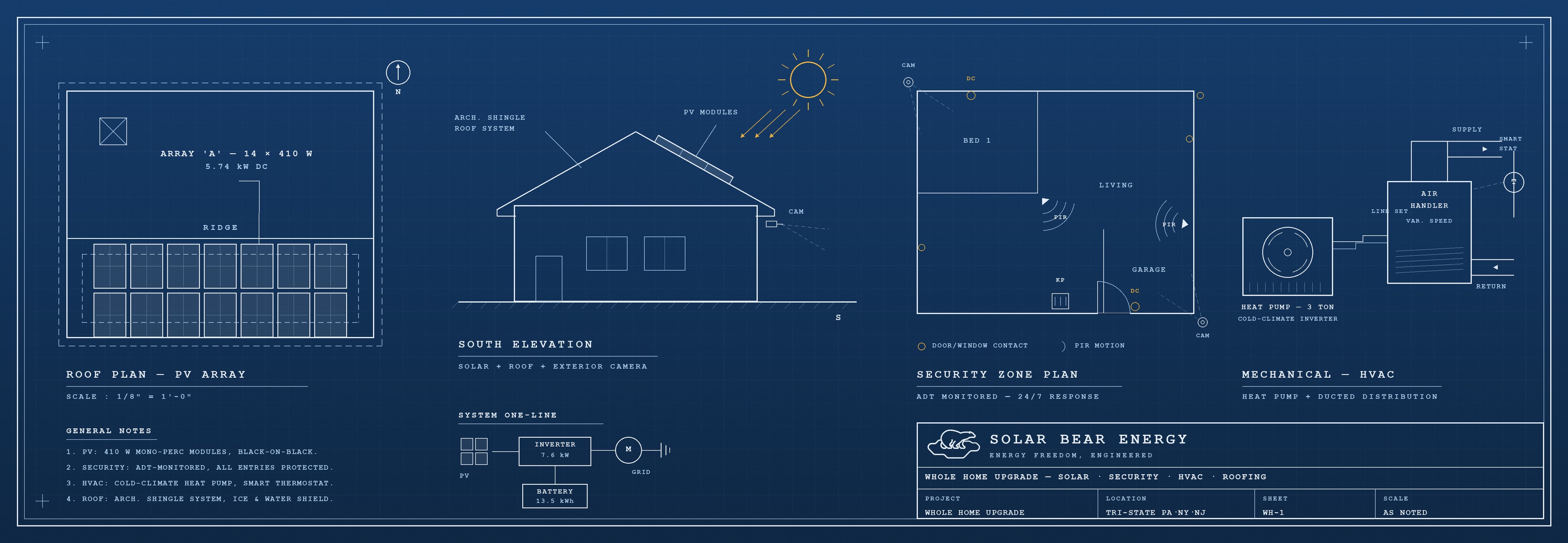
This is why our services page is not just a solar page. On plenty of houses around here the largest single available change is a properly sized cold-climate heat pump replacing resistance heat, or air sealing a rim joist, not another kilowatt of modules.
Which parts of your bill you can actually move
| Line on your bill | Who sets it | Can you shop it | Can self-generation offset it |
|---|---|---|---|
| Supply / price to compare | Wholesale market, reset June 1 and Dec 1 | Yes | Yes |
| Distribution per kWh | PA PUC, in a rate case | No | Yes |
| Fixed monthly customer charge | PA PUC, in a rate case | No | No |
| Riders, surcharges, gross receipts tax | PA PUC and statute | No | No |
| Kilowatt-hours used | You | No | Yes |
Read that table in order. The kilowatt-hours line is the one at the bottom and it is the one you have the most authority over, which is the opposite of how most people prioritize.
Shopping the supply half is worth doing, with your eyes open. Competitive offers on PA PowerSwitch are real, but read the term: introductory rates that roll to a variable rate, early cancellation fees, and the fact that the price to compare itself changes twice a year, so a fixed offer that beats it in July may not in December. Shopping changes the supply half only. Your delivery charges are identical either way.
Generating some of it yourself works through Pennsylvania's net metering rules, which require electric distribution companies to net residential customer-generator systems up to 50 kW at the full retail rate. That is the mechanism that matters: a kilowatt-hour you produce and use is a kilowatt-hour you do not buy, including the delivery charges on it. Excess you export is credited, and any leftover at the end of the annual period is trued up at the price to compare rather than at retail, which is one honest argument against oversizing an array. Pennsylvania also has an alternative energy credit market that solar owners can participate in. We keep what is actually true about incentives in 2026 current on its own page, including the federal credit that homeowners could claim for buying their own system, which ended for systems installed after December 31, 2025.
If ownership is not the right structure for your household, the difference between owning a system and a lease or PPA is a separate conversation worth having before anyone talks about equipment.
Where solar honestly fits, and where it does not
Plainly, so nobody is surprised later:
- Solar reduces the kilowatt-hours you buy. It does not delete the fixed monthly customer charge, and it does not exempt the power you still import from the next distribution rate case.
- Because net metering credits at retail, a system's value rises when retail rates rise. That cuts both ways, and it is the actual mechanism rather than a promise.
- Production is seasonal. A December in Pike County is not a June. A system is sized to a twelve-month usage profile, not to a summer bill.
- A battery does not lower your rate here. It answers outages. On the radial sections of the PCL&P system, and out in PPL territory where the canopy is heaviest, that is a real conversation, but it is a reliability decision. We wrote up how we think about backup power for outage-prone homes separately.

Who this is not right for
This is the section most solar pages leave out.
- Heavily shaded lots. Pike County's mature hardwood canopy is the single most common reason we tell a homeowner no. A ground mount in a clearing sometimes solves it and sometimes does not, and the honest version of that answer comes from standing on the property.
- A roof near the end of its life, unless the roof is being addressed first. Setting a twenty-five year array on decking with five years left in it means paying to remove and reset it later.
- Anyone selling within a year or two.
- Very low usage, such as a seasonal cabin used a few weekends a year. There is not enough consumption there for the arithmetic to be interesting.
- Households whose real pain is the gas bill. Phase 2 of PCL&P's approved natural gas increase takes effect October 15, 2026, adding 12.7 percent for a typical residential heating customer on top of the 20.4 percent that landed in October 2025. That affects roughly 1,400 gas customers in Matamoras Borough and part of Westfall Township. Solar does not touch a gas bill. Insulation, air sealing and heating equipment do.
The local wrinkle: what a very small utility means for your project
If you do decide to put a system on the roof, the utility you are on changes the paperwork more than most people expect.
PCL&P serves about the number of customers a single subdivision holds in other parts of the state, and it does not process the volume of interconnection applications PPL does. Its territory is a leftover of Orange and Rockland's system, sold out of Orange and Rockland in 2016 and since passed to other owners, which is why Milford and Matamoras sit on a different utility than the rest of Pike County and why the wires above your street connect to New York. We confirm current interconnection requirements with them project by project rather than assuming last year's answer still applies.
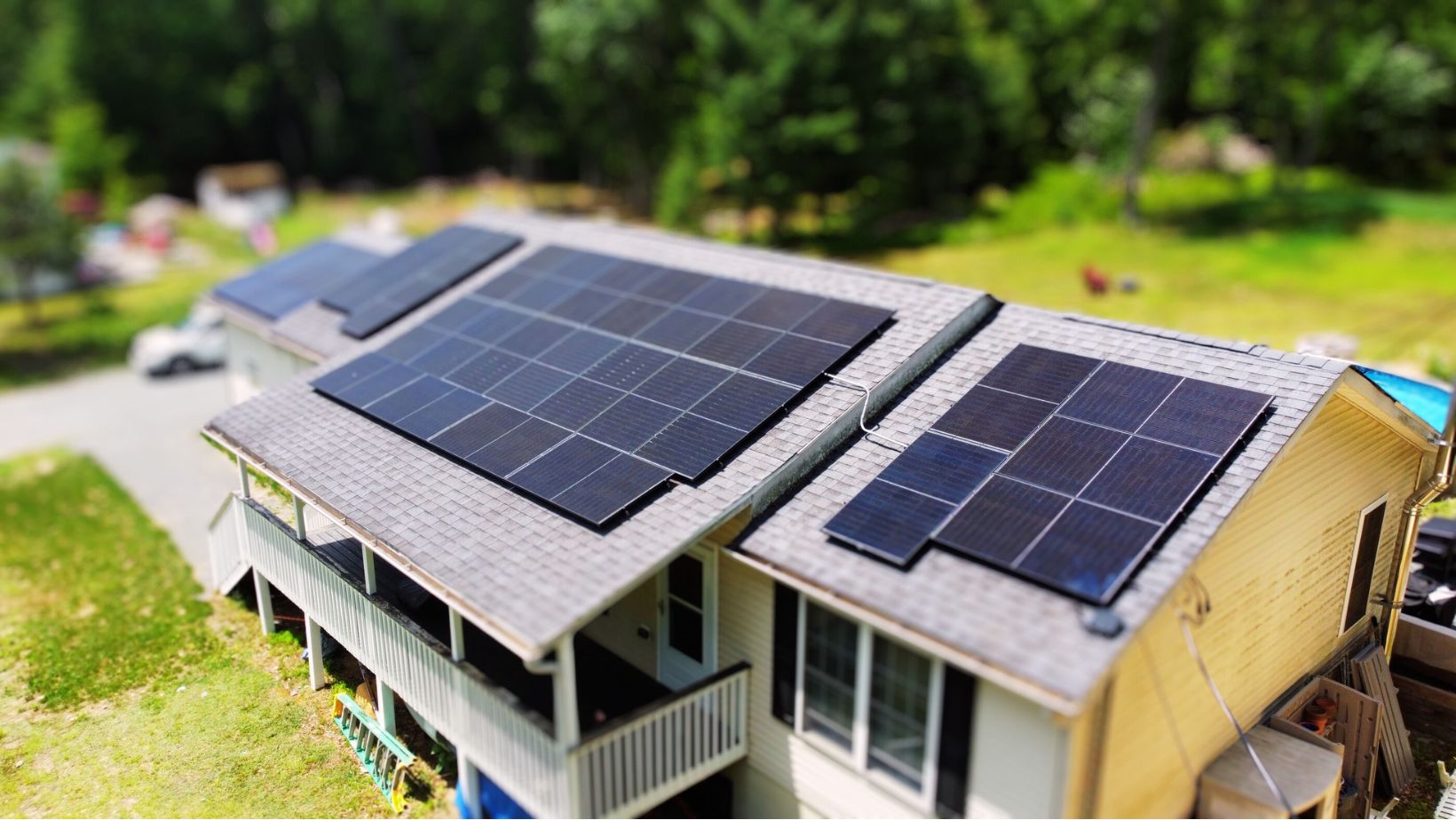
The permitting side is separate again, and local. Milford Borough, Matamoras Borough, Westfall Township, Milford Township and Dingman Township each run their own review, and Milford's older housing stock brings its own questions about decking and about how visible an array will be. We walk through the real sequence from signed design to permission to operate in a separate post, and you can see work we have already carried through that process.
What to do this week, whether or not you ever call us
- Pull out your bill and physically find the two halves. Supply on one side, delivery on the other. Note which one grew.
- Find the price to compare printed on the bill, then look at what competitive suppliers are offering for your utility on PA PowerSwitch. Read the contract terms, not the headline rate.
- Pull twelve months of kilowatt-hours, not one month. A single July bill tells you about July.
- Walk the house for the loads nobody counts: the dehumidifier, the second refrigerator in the garage, the resistance baseboard in the addition, the pool pump schedule.
- If you are on PCL&P gas in Matamoras or Westfall, put October 15 on the calendar now rather than being surprised by it.
Then, if it is worth a real look, get someone on the roof. A site evaluation is the only way to answer what a specific roof, a specific tree line and a specific usage profile would actually offset. We will give you that answer straight, including when it is no.
What we would tell a homeowner considering this
- Your bill has two halves. You can shop the supply half and you cannot shop the delivery half, and they change for completely different reasons.
- Pike County Light & Power buys power in the New York market, not PJM. That is why Milford and Matamoras saw 19.8 percent while PPL customers a few miles west saw 1.5 percent.
- The next scheduled supply change is December 1. Gas customers in Matamoras and Westfall have a separate increase landing October 15.
- In a Pike County July, how much you use moves the bill more than the rate does. Start there before you start anywhere else.
- Solar reduces the kilowatt-hours you buy. It does not delete the customer charge. Size it to twelve months of real usage, not to a sales target.