Yes, and less than in June. A solar array in Pike County or Sussex County still produces on every clear January day, but three things work against it at once: the days are short, the sun sits low, and snow sometimes sits on the glass. That combination makes January the low month of the year here. In Pennsylvania the billing side is annual rather than monthly, and 52 Pa. Code 75.12 defines that net metering year as June 1 through May 31.
Why January is the low month
Three separate effects stack up, and it helps to keep them apart, because only one of them is about snow.
Short days. Sunrise is late and sunset is early. The array has fewer hours to work with, and the first and last hours of those are worth very little because the light is coming through a lot of atmosphere. You can pull the actual sunrise, sunset and solar noon times for your own coordinates from NOAA's solar calculator, which will build a table for a whole year.
Low sun angle. At our latitude the sun at midday in January is far lower in the sky than it is in June. A roof pitch and azimuth that are close to ideal in summer are off axis in winter, so the same array collects less from the same clear sky. NOAA's solar position calculator reports elevation in degrees up from the horizon for a given date and location, and running your own address for a January noon and a June noon is the fastest way to see the difference for yourself.
Snow cover. This is the one homeowners ask about, and it is the least predictable of the three. Snow is an on and off loss, not a constant one. An array can be buried for two days, clear for nine, and buried again. The question is never whether snow lands on your roof in Lords Valley or Montague. It is how fast it leaves.
A fourth thing is working quietly in your favor. Cold improves module voltage. On a clear, hard, blue January afternoon a clean array can hit numbers that look surprisingly close to a hazy day in August, for the couple of hours the geometry allows it.
What actually happens when snow lands on an array
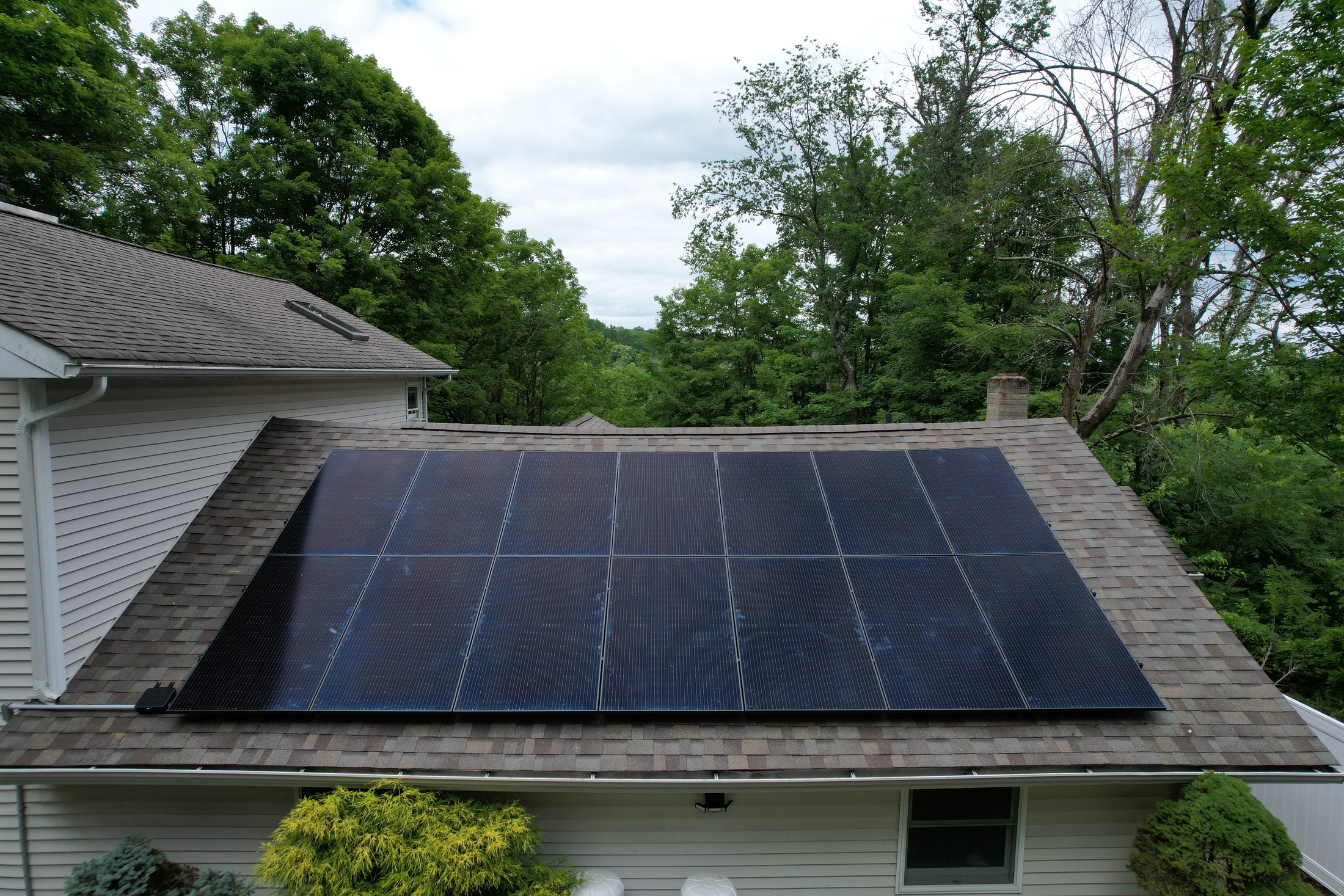
Glass is slicker than asphalt shingle. Modules are dark and absorb what light gets through. So the usual sequence on a pitched roof is that a thin melt layer forms under the snow, the pack loses its grip at the bottom edge, and the whole sheet goes at once, often in a slab that lands hard enough to take a gutter apron with it if nobody thought about it.
That sequence is why the things we look at during a winter minded design are structural, not electrical.
- Where the slab lands. Over a front door, a heat pump, a propane tank or a basement bulkhead is a problem. Sometimes the fix is snow guards below the array. Sometimes it is moving three modules.
- The eave detail. Arrays do not cause ice dams, but a roof that already dams at the eave will keep a wet band at the bottom of the array longer than the rest of it clears.
- Racking and flashing. Freeze and thaw is hard on a penetration that was done in a hurry. The winter you find that out is the worst time to find it out.
- What the array sits on. If the shingles are near the end, the array goes on after the roof, not before. Our sister company All In One Building LLC handles that side of it when a roof has to come first.
One more piece of honesty about snow: it rarely clears evenly. It clears from the bottom up, or from one plane before another. That is where your inverter architecture matters. On a plain series string, a partly covered array can drop a lot harder than the covered fraction suggests, because the whole string follows its weakest module. With module level electronics such as SolarEdge optimizers, the modules that are clear keep contributing while the buried ones sit out. We talk through that tradeoff in our rundown of the equipment we install.
How different setups shed, and what we do about each
| Setup | How snow usually leaves | What we plan for |
|---|---|---|
| Steep pitch, south facing | Fastest. Sun gets under the pack, it slides in slabs | Where the slab lands, snow guards, gutter protection |
| Moderate pitch, east or west planes | Slower, and the two planes rarely clear on the same day | Module level electronics so one clear plane still produces |
| Low slope or nearly flat roof | Slowest. Snow can sit until it sublimates or rains off | Tilted racking if the structure and the wind zone allow it |
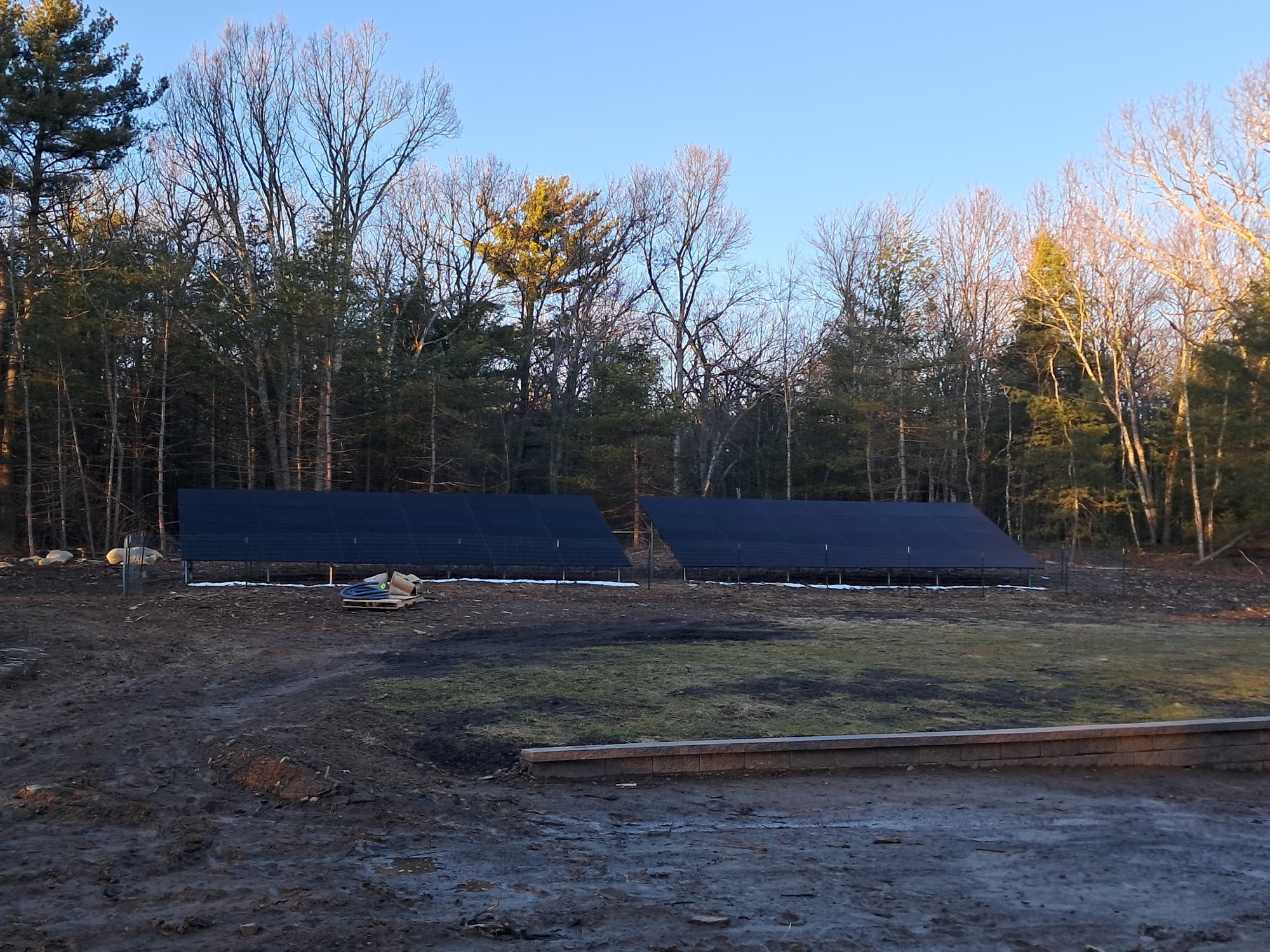
| Ground mount | Bottom row can get buried by drift or by what slides off it | Height above grade, row spacing, and clear access |
The ground mount row is the one that surprises people. A ground mount is easier to reach, easier to clean, and can be set at a steeper winter friendly tilt, but it is also the only array that can be buried from below by its own shed pile. We went through the rest of that comparison in ground mount versus roof mount in Pike County.
Trees matter more in January than in July for the same geometric reason the sun angle does. A bare oak still casts a real shadow, and a low sun throws that shadow much further across the roof. If your site has a tree problem, it is a winter problem first, and we covered how we handle it in designing around shade in the Poconos.
Send an address and one photo of the roof taken from the driveway, plus the name of the utility that bills you. That is enough for us to say how that roof is likely to behave in January. Start with the address or look through finished installs in the area first.
The local wrinkle: your bill is annual, not monthly
This is the part that changes how a January number should feel.
In Pennsylvania, 52 Pa. Code 75.13 says that when a customer generator sends more electricity to the system than the utility delivers in a billing period, the excess kilowatt hours are carried forward and credited against usage in later billing periods. At the end of the year, the default service provider compensates the customer generator for any remaining excess kilowatt hours at its price to compare rate, and remaining distribution credits are zeroed out rather than carried into the next year. The year, per 52 Pa. Code 75.12, is June 1 through May 31.
Read that in order and the seasonal shape makes sense. The credits you build in June, July and August are the ones sitting in the account when the days get short. January is when the bank gets drawn down. That is the design working, not failing. We walk through how this reads on an actual statement in the Pennsylvania net metering true up post, and the price to compare line itself gets its own explanation in what the price to compare actually is.
Two cautions. First, that rule is Pennsylvania. If the house is in Orange or Sullivan County, New York, or in Sussex County, New Jersey, the netting rules and the annual reset are set by that state and by your utility's own tariff, and we are not going to quote a New York or New Jersey rule here that we have not read against your account. Second, which utility serves a given house is decided by the address, not the township. Tell us who sends the bill and we will work from that.
What estimating tools do and do not include
If somebody handed you a month by month production table, ask what it assumed about snow. NREL's PVWatts calculator is the common reference, and its own documentation is direct about this: the snow loss input is a reduction in annual output from snow covering the array, and the default value is zero, assuming either that there is never snow on the array or that the array is kept clear. The tool also allows monthly irradiance losses to represent snow instead.
That is not a knock on the tool. It is a note about the estimate you were handed. A January figure produced with the default assumptions describes a January where nothing ever lies on the glass. Neither the tool nor anybody else can tell you what this coming winter will actually drop on Dingman Township. What an honest design does is minimize the time snow stays, and be candid that some of it is weather.
Who this is not right for
Solar is a poor fit for some houses here, and winter is usually the reason.
- A north facing roof with no usable south or west plane. Summer will paper over it. January will not. If a ground mount is not possible on the lot, the answer may be no.
- Heavy standing timber right at the south edge of the clearing. If the winter shadow crosses the array for most of the usable window, the array is not going to earn its keep, and pretending otherwise is how people end up angry in February.
- A seasonal cabin used mostly in winter. If your load is concentrated in exactly the months production is lowest, the annual banking logic above works against you rather than for you. That is a different conversation, usually about backup power instead.
- A roof with a few years left in it. Do the roof first. Removing and resetting an array later is real money and real roof penetrations done twice.
- Anyone who will be checking the app daily in January. If a day of zeros will ruin your week, the seasonal shape of this technology is going to bother you no matter how well the system is built.
What we would tell a homeowner considering this
Judge the system on the year, not the month. Ask for a monthly table instead of an annual number, and ask what was assumed for snow. Look at the roof planes and ask where the snow will go when it lets go, because that answer decides whether snow guards belong in the design. If the string design can be made tolerant of partial cover, that is worth more here than it would be in a milder climate.
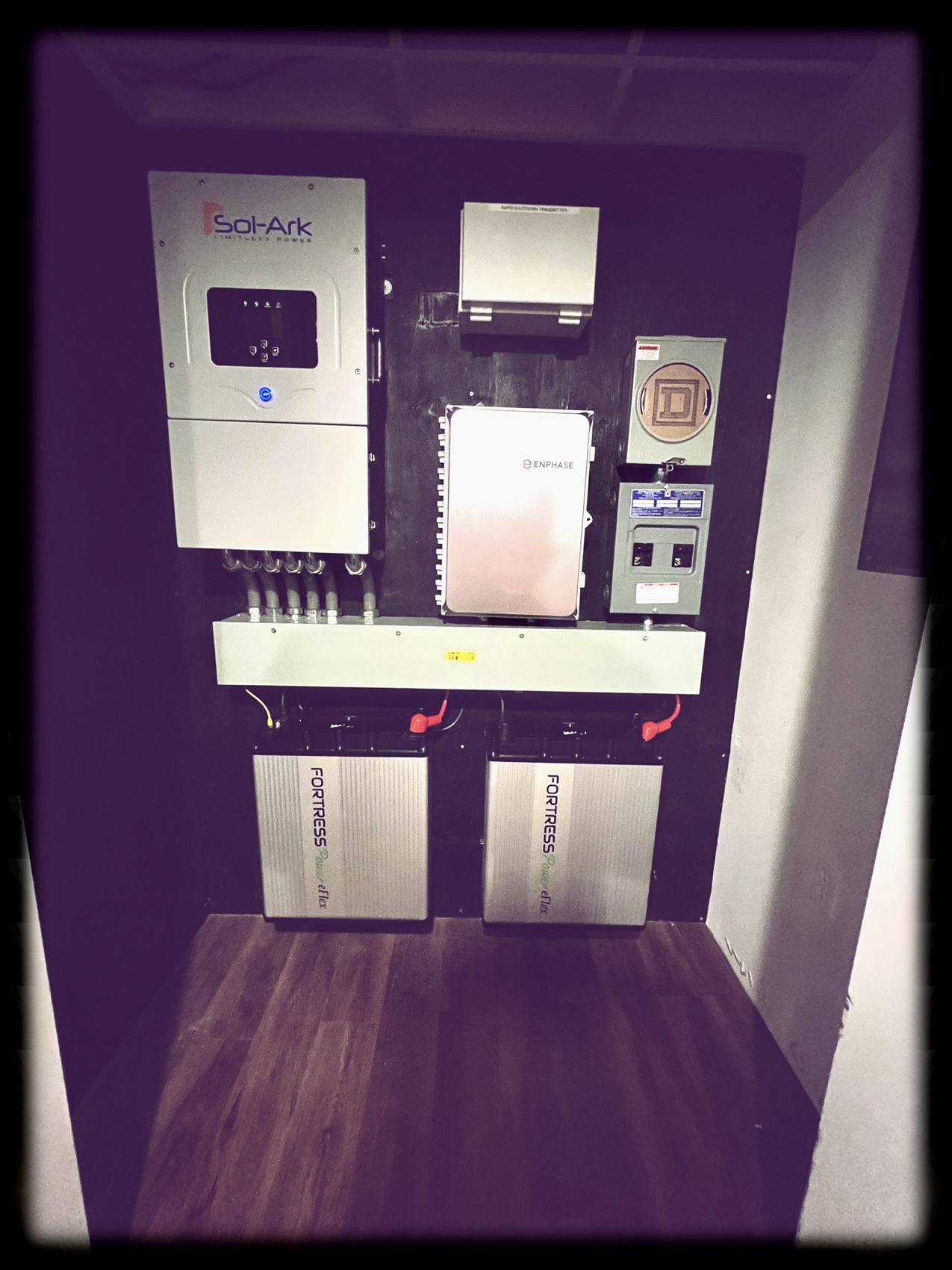
If your real worry is not production but the lights going out during a January storm, that is a battery or a standby generator question rather than a panel question, and we covered it in the Poconos battery backup guide. We install EG4, Sol-Ark, SMA, SolarEdge, APsmart, Sungrow, SunPower and Generac, and we do not service Tesla systems.
You can see the full list of what we do on the services page, including the roofing and HVAC side, since around here those three trades end up in the same conversation more often than not. When you are ready, send us the address and the utility name or call the office at (570) 500-2327.
Program rules, tariffs and utility practices change. The Pennsylvania net metering provisions described here are quoted from the Pennsylvania Code as published at the links above, and New York and New Jersey rules differ. Verify anything that affects your budget against the primary source or your own utility account before you rely on it.
What we would tell a homeowner considering this
- January is the low month of the year here, and a well designed array is still working on every clear day of it.
- Snow cover is intermittent, not constant. What matters is how fast a given roof sheds, which comes down to pitch, orientation and what is below the array.
- In Pennsylvania the net metering year runs June 1 through May 31, so summer credits are what carry a winter bill.
- Do not climb up to sweep panels. Nothing you clear is worth a fall or a scratched module.
- Estimating tools do not model snow unless you tell them to. Ask whoever quoted you what they assumed.