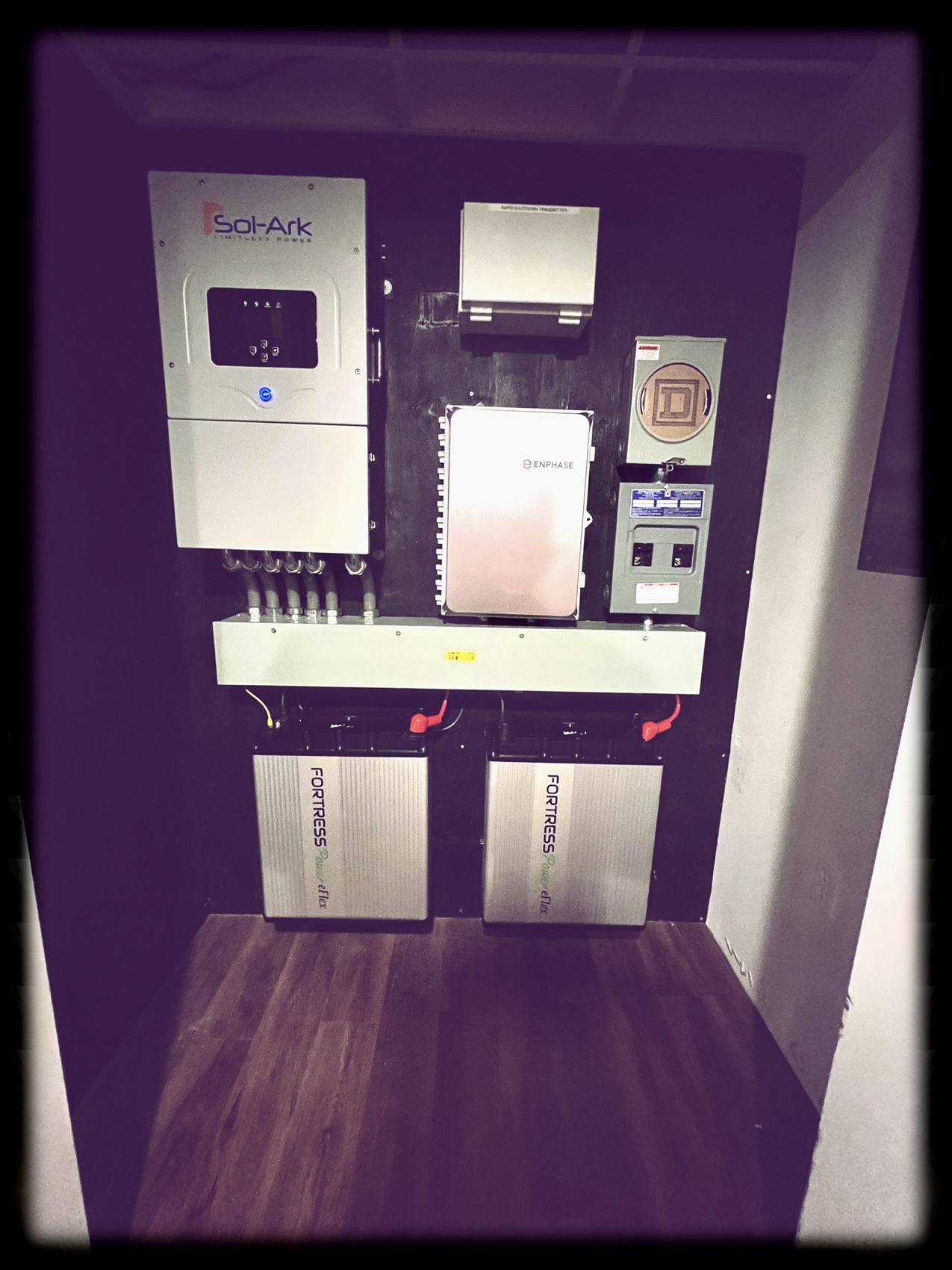
A net metering true-up is the once-a-year settlement of the kilowatt-hours you pushed to the grid and never used back. Through the year those exported kilowatt-hours sit on your account and offset the kilowatt-hours you pull, one for one. At the end of the net metering year the leftovers stop being kilowatt-hours and get cashed out at your utility's price to compare, which is lower than full retail. Then the counter goes to zero and the next year starts empty.
There are two numbers on your meter, not one
Before any of the credit math makes sense, you have to accept that a net-metered house has two readings. The meter records what the utility delivered to you and, separately, what it received from you. PPL's net metering rider is written in exactly those words, comparing kilowatt-hours received from the customer-generator against kilowatt-hours delivered by the company, and it credits the excess against your usage in later billing periods at the full retail rate (PPL Electric net metering tariff supplement).
That is the whole engine. Every line item on the bill is downstream of those two registers.
The number people fixate on is the net. Your bill shows a small usage figure in June and you assume the system is carrying the house. The number that decides what happens next May is the running credit balance, and on most bill formats it is printed somewhere quieter, near the meter reading detail rather than in the amount-due box.
Walking the line items
A residential electric bill in this footprint breaks into roughly four buckets. Net metering touches them unevenly, and that is the part that surprises people.
The fixed customer charge. This is billed whether your array made a hundred kilowatt-hours that month or three thousand. FirstEnergy's Pennsylvania net metering rider application says it plainly: the customer-generator is responsible for the customer charge, the demand charge and other applicable charges under the applicable rate schedule (FirstEnergy PA net metering rider application). Exported kilowatt-hours do not erase a fixed charge. They were never going to.
Distribution charges. These are per-kilowatt-hour and they follow your net delivered usage. In a month where your credits wipe out delivered usage entirely, the per-kilowatt-hour distribution line goes to nothing and the fixed charge stays.
Generation supply. If you take default service, this is the price to compare. If you shop, this is whatever your supplier's contract says. Either way, this is the biggest per-kilowatt-hour component and it is the one your credits are worth the most against.
Riders and surcharges. Alternative energy, energy efficiency, universal service, state tax adjustment. They ride along on the same tariff and they do not vanish because you exported.
So the honest read of a good solar month is not that the bill went away. It is that the variable buckets went to nothing and the fixed bucket did not. We wrote about how those fixed and variable pieces have been moving locally in what is actually driving Milford electric bills up.
Send us a photo of last month's bill, both pages, and tell us which utility name is printed on it. We will tell you which line items your array is actually offsetting and which ones it never will. No site visit needed for that conversation. Start here or call the office at (570) 500-2327.
Which credits roll, and which ones quietly expire
Under Pennsylvania's net metering regulation, excess kilowatt-hours that are not offset by your usage in later billing periods keep accumulating until the end of the year (52 Pa. Code § 75.13). That is the rollover everyone means when they say credits roll. April surplus covers August air conditioning. May surplus covers January resistance heat, if you get that far.
The same section says what happens at the end of the year. The default service provider compensates you for any remaining excess kilowatt-hours at its price to compare rate. Not at retail. The price to compare covers generation and transmission and leaves out distribution, so a kilowatt-hour that was worth a full retail offset in February is worth less as a May cash-out.
That is the thing to understand about sizing. A kilowatt-hour you consume yourself, or offset within the year, is worth more than a kilowatt-hour you bank past the deadline. The regulation does not punish you for overproducing. It just stops paying retail for it.
When your net metering year actually ends
If you are on PPL, the rider ties the accumulation to the PJM planning period ending May 31, and the annual compensation is paid on that basis (PPL net metering tariff). The reporting obligation in the state regulation runs on the same calendar, with utilities reporting to the Commission for the period ending May 31 each year (52 Pa. Code § 75.13).
Which utility serves your address decides this, not which township you live in. Two houses on the same road in Dingman Township can bill differently. Read your own rider, or send us the bill and we will read it with you.
Four things that close your year early
The May 31 date is the normal case. Several ordinary decisions end the year before that, and none of them feel like they should.
- Switching electricity suppliers. If a customer-generator switches suppliers, the utility treats the end of the service period as if it were the end of the year (52 Pa. Code § 75.13). Your banked kilowatt-hours settle then, at the lower rate, in whatever month you happened to sign.
- Changing rate schedules or shopping status. PPL's rider says compensation also occurs if the customer changes rate schedules or shopping status (PPL net metering tariff). Moving onto a time-of-use schedule is not a neutral act in a year where you are carrying a big spring balance.
- Shopping in the first place. If you buy supply from a competitive supplier, the credit or compensation terms for your excess electricity are set in your service agreement with that supplier, not by the utility's rider (52 Pa. Code § 75.13). Read the contract before you sign it. A door-knocked supply offer and a solar array are two things that need to be introduced to each other.
- Selling the house. Net metering attaches to the account and the meter. When the account closes, the year closes with it.
Alternative energy credits are a separate ledger
The kilowatt-hour credits on your bill are not the same thing as the alternative energy credits your production generates. The regulation says a net-metered customer-generator owns the alternative energy credits for the electricity it generates, unless there is a contract with an express provision assigning them to someone else, or the customer expressly rejects any ownership interest (52 Pa. Code § 75.13).
"Unless there is a contract" is doing real work in that sentence. Lease and power purchase agreement paperwork routinely assigns those credits away, which is one of several reasons we lay out the differences on our ownership versus PPA page.
Pennsylvania, New York and New Jersey side by side
| Pennsylvania | New Jersey | New York (Orange & Rockland) | |
|---|---|---|---|
| Monthly rollover | Excess kWh accumulate until end of year (§ 75.13) | Credits bank month to month (JCP&L net metering billing) | Net meter energy credit carries on the account (O&R FAQ) |
| Annual settlement | Remaining excess paid at the default service provider's price to compare (§ 75.13) | Remaining banked credits compensated at the avoided cost of wholesale power (JCP&L) | Remaining credit valued using the cost of wholesale power (O&R FAQ) |
| Who picks the year-end | Set in the utility's rider; PPL uses the PJM planning period ending May 31 (PPL tariff) | The customer-generator selects an annualized period under N.J.A.C. 14:8-4.3 (NJ BPU notice) | Rate option may be elected once per year on the customer's anniversary date (O&R FAQ) |
| Supplier switch | Utility treats end of service period as end of year (§ 75.13) | Old supplier pays out the bank and it resets, calculated like an annual true-up (JCP&L) | Not addressed on the page we read this run |
| Extra monthly charge to know about | Customer charge and other rate schedule charges still apply (FirstEnergy PA rider application) | See your utility's net metering page | Mass market net metering customers pay a monthly non-bypassable Customer Benefit Contribution (O&R FAQ) |
New Jersey's avoided cost of wholesale power is defined in BPU rule language as the average locational marginal price of energy in the applicable utility's transmission zone (NJ BPU). That is a wholesale number, not a retail one, which is the same shape of haircut Pennsylvania applies.
The local wrinkle: this is being renegotiated right now
Net metering in Pennsylvania is not a settled thing you can look up once. On June 4, 2026 the Public Utility Commission issued its decision in PPL Electric's base rate proceeding, and the Commission's own announcement says the approved settlement addresses emerging issues related to large-load customers and customer-generators, with PPL to file a compliance tariff for service rendered on and after July 1, 2026 (PA PUC). The Commission also adopted a modification clarifying that agricultural biogas customer-generators are not swept into a classification designed for large, no-load net-metering facilities.
Read that carefully, because it tells you where the fight is. Classification is the lever. Which bucket your account sits in decides what your exports are credited at, and that is decided by tariff language approved by the PUC, not by your installer and not by a sales rep.
What this means practically for a homeowner in Pike County: the version of your rider that was accurate when you signed a proposal may not be the version in force at your next true-up. Pull the current rider from your utility. FirstEnergy posts the Met-Ed, Penelec, Penn Power and West Penn Power rate district tariffs on its Pennsylvania tariffs page, and FirstEnergy's Pennsylvania FAQ states that excess energy received from the customer is credited to the account at the applicable generation component of the customer's rate schedule (FirstEnergy PA FAQ).
Who this is not right for
Not everyone should be planning around a true-up, and a few people should not be planning around one at all.
If a cooperative sends your bill. Subchapter B of Chapter 75 sets net metering requirements for electric distribution companies and electric generation suppliers (52 Pa. Code Subchapter B). If your electricity comes from a rural electric cooperative, ask the co-op directly what its own policy is. Do not assume the state rule you read online applies to your account.
If the plan is to oversize and bank. Building an array well past your annual usage in order to run up a balance does not work the way people hope, because the surplus settles at a wholesale-flavored rate rather than a retail one. Sizing to your own consumption, and then shifting more of that consumption onto your own production, is the better play. That is a big part of why we talk about batteries in terms of load shifting and outage coverage rather than credit farming.
If shade is the actual problem. A true-up cannot fix a production shortfall. If the roof is under oaks, the conversation is about solar with tree shade in the Poconos or about putting the array on the ground instead, not about credit mechanics.
What we would tell a homeowner reading their first true-up
Find the credit balance line, not the amount due. Learn the month your year closes. Do not sign a competitive supply offer in April without checking what it does to a balance you spent all spring building. And if the bill format changed and you cannot find the credit line at all, that is normal, and it is a ten-minute phone call.
We read these bills for people in Milford, Matamoras, Dingmans Ferry, Port Jervis and across the line into Sussex County, including on systems other companies installed. You can see the kind of work behind the meter on our projects page, and the full list of what we do is on the services page.
What we would tell a homeowner considering this
- Exported kilowatt-hours offset your usage one for one during the year, but leftovers at year-end are cashed out at the price to compare, not at retail.
- The fixed customer charge is not offset by exports. FirstEnergy's Pennsylvania rider application says the customer-generator still owes the customer charge and other rate schedule charges.
- Switching electricity suppliers closes your net metering year early and settles your balance at the lower rate, whatever month it happens in.
- If you buy supply from a competitive supplier, your excess-generation terms live in that contract, not in the utility's rider.
- PPL's classification of customer-generators was part of the rate settlement the PUC decided on June 4, 2026, with a compliance tariff for service on and after July 1, 2026. Pull your current rider before you assume anything.