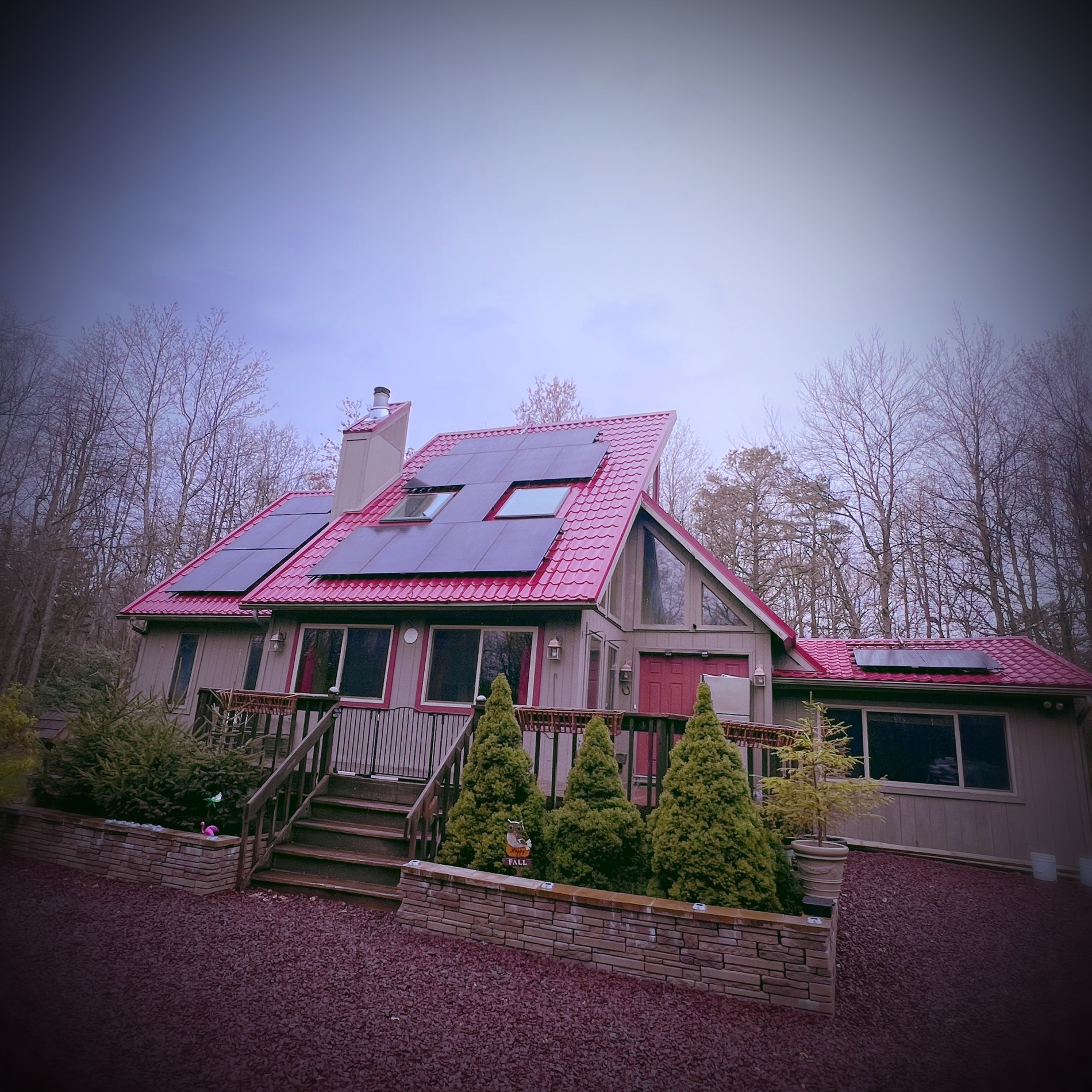
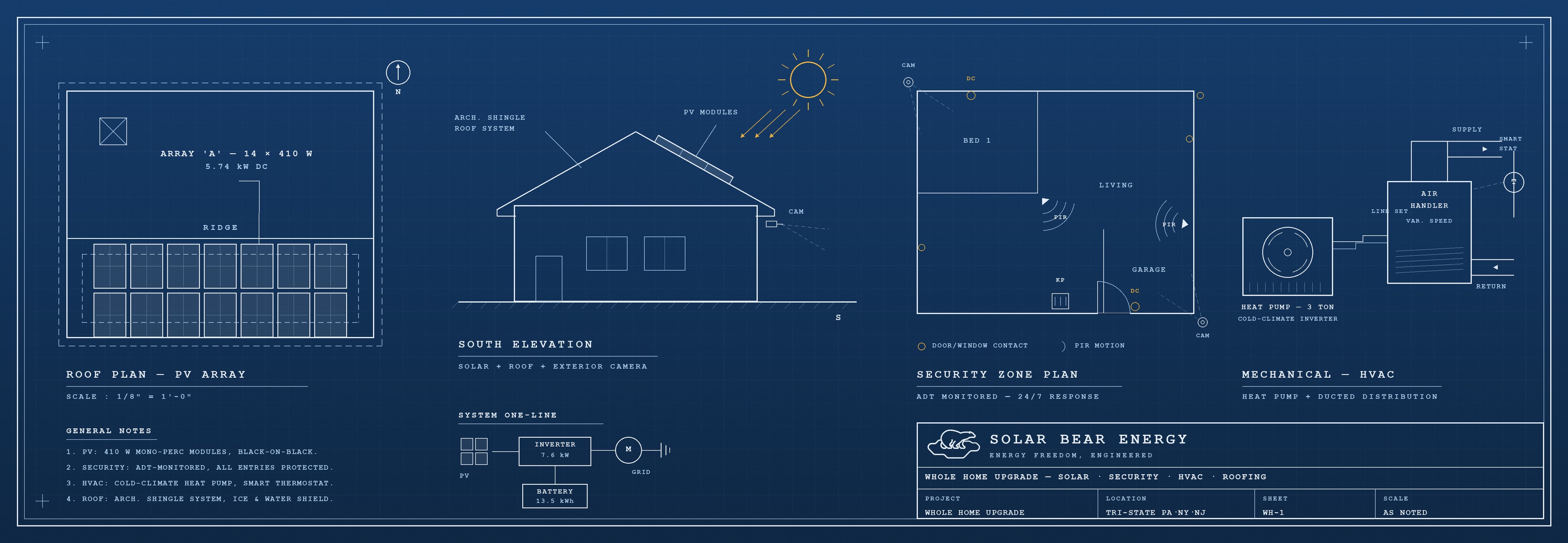
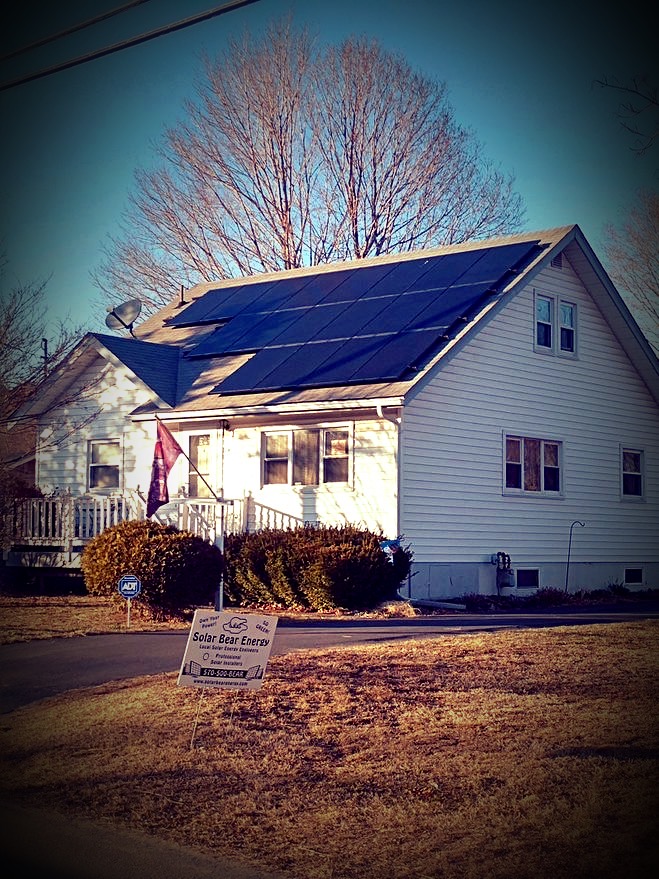
A ground mount is usually the right call when the roof is shaded, wrong-facing, undersized, or close enough to a replacement that you would rather not put an array on it twice. It is usually the wrong call when the open ground is far from the meter, wet, or steep. The deciding factors on a Pike County lot are the trench length, the soil, the setbacks your township enforces, and how the roof itself is aging.
What a ground mount actually is on this kind of lot
On a two-acre lot in Dingman Township or a five-acre lot outside Narrowsburg, "we have plenty of land" is true and still not the whole answer. A ground mount is three separate builds stacked into one project. There is a foundation, either driven piles or concrete piers. There is a racking structure carrying modules at a fixed tilt, sized for wind and snow load on that specific site. And there is a buried circuit that gets the power from the array back to the house.
Any one of those can be simple. The one that decides whether the project is straightforward or a headache is almost always the third one.
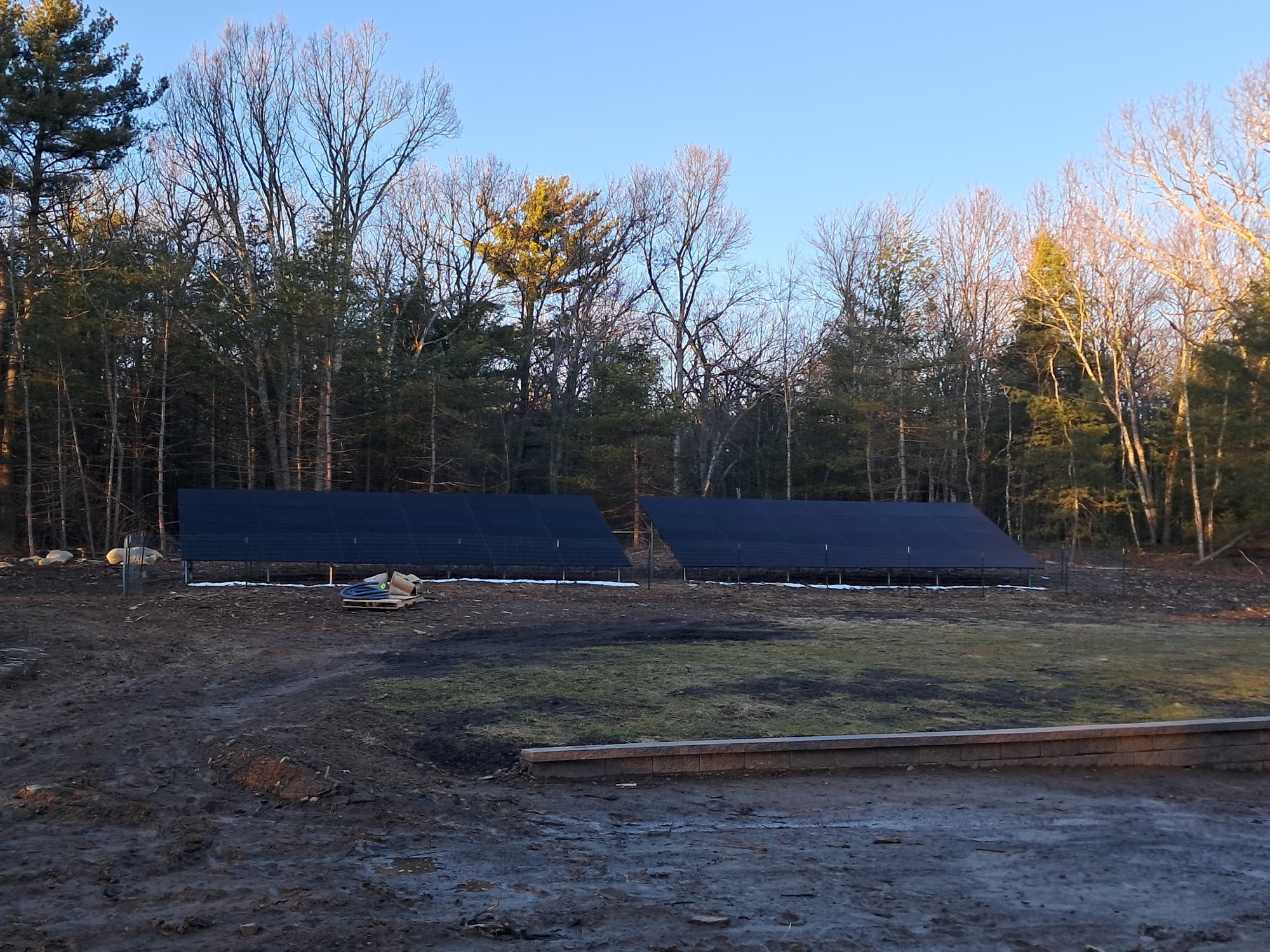
We look at four things before we even sketch a layout.
Where the open ground is relative to the meter. Not the property line. The meter. Every extra foot of trench is excavation, conduit, larger conductors to hold voltage drop down, and restoration of whatever you dug through.
What the soil does. Pike County soil is not one thing. We hit clean glacial till in one field and bedrock at eighteen inches in the next one, sometimes on the same parcel. Shallow rock changes the foundation from driven pile to drilled and set, and that changes the schedule.
Whether the ground is actually dry. A low spot that holds water in April is a low spot that holds water under your array in April. Seasonal high water table shows up in Pike and Sullivan County more often than homeowners expect.
What is already buried out there. Well lines, septic laterals, the propane run to the generator, the old direct-burial feed to the barn that nobody documented. This is where projects go sideways.
The trench is the part people underestimate
Before anything gets dug, the site gets marked and the one-call notice goes in. In Pennsylvania homeowners and contractors must call 8-1-1 at least three business days before digging, as required by law, and the notice requirement under Act 287 as amended reaches private landowners, not just contractors, for any digging with powered equipment. The same source explains the part most people skip, which is marking the proposed excavation area in white before you place the call.
One-call marks member-owned utilities. It does not mark your septic field or the water line you ran to the garden in 2009. On rural Pike County properties, the buried things that cause damage are usually the ones the homeowner installed. If you have any idea where they are, tell us, even if you are only half sure.
Trenching also disturbs earth, and earth disturbance in Pennsylvania carries erosion and sediment control obligations under 25 Pa. Code § 102.4. DEP publishes an erosion and sediment control FAQ that covers how the requirements are applied. For a short residential trench and a modest array footprint this is usually a plan on paper and some silt fence, not a permitting saga. We ask the county conservation district before we assume which it is, because the answer depends on how much ground the project actually opens up and where the water goes when it leaves your site.
There is one more trench decision that changes the whole design: whether you run DC out to the array and put the inverter at the house, or invert at the array and run AC back. Long runs, big arrays, and future battery plans all pull that decision in different directions. It is a real engineering choice, not a preference.
Frost depth, soil, and what holds the array down
Footings have to bear below the frost line. That is not a Solar Bear opinion, it is how foundations work here, and the depth that gets enforced is the depth the building code official for your municipality enforces. We confirm it with that office in writing rather than quoting you a number from a chart, because the number that matters is the one on the inspection.
Under the Pennsylvania Uniform Construction Code, a permit is required before you construct or alter a structure or install the electrical work that goes with it, and that section is also where the exemptions live. A ground mount is a structure with an electrical system attached to it, so plan on drawings, a plan review, and an inspection. That is normal. It is also why a ground mount takes longer on paper than a roof array on the same house.
Three foundation types come up in this footprint. Driven piles are fast and clean when the soil cooperates. Drilled piers with concrete are what shallow bedrock and loose fill get you. Ballasted or non-penetrating systems occasionally solve a site where you truly cannot dig, and they carry their own load and layout constraints.
Snow matters more on the ground than on the roof, and in a different way. A tilted array sheds snow, and the snow has to land somewhere. If the bottom edge sits low, that pile builds back up against the modules. We set the low edge with local snow in mind, and we leave room to walk the back of the array with a snow rake if you want to.
What we install on ground mounts and why
Ground mounts are where string inverters earn their keep. With clean unshaded rows and identical orientation, a Sol-Ark or Sungrow string inverter at the house gives you fewer components out in the weather and a simpler troubleshooting path when something does go wrong five years from now. Where the array has to be split across two orientations, or a tree line clips one row in the winter, SolarEdge or module-level electronics start making sense again for the same reason they do on a roof.
Rapid shutdown is worth asking about directly. The requirements that drive module-level electronics on rooftops were written around arrays on buildings, and how they apply to a freestanding array in a field is a question the code official reviewing your plans answers, not a question a salesperson answers. We ask before we design, and we tell you what the answer was.
If storage is part of the plan, the battery and the inverter go at the house, not at the array. That keeps the electronics in a conditioned or semi-conditioned space and keeps the long run doing one job. We wrote about how that plays out in battery backup for Poconos homes. Ground mounts also tend to expose panel capacity problems, because you are landing a new circuit and often a new subpanel. What your main service panel can actually accept is worth reading before you get attached to an array size.
For roofing that is genuinely at the end of its life, our sister company All In One Building LLC handles the roof side, which matters here mostly because it changes the sequence: roof first, array second, or array on the ground and the roof stays a roof.
Send us the property address, a photo of the meter and main panel, and a rough idea of where the open ground is relative to the house. Tell us which utility bills you. That is enough for us to say whether a ground mount is worth pricing on your lot, or whether the roof is the better place for the array. Start with an address
Setbacks, zoning, and who actually decides
Here is the part that surprises people who bought land specifically so they could put things on it. A ground mount is generally treated as an accessory structure, and accessory structures are governed by your municipality's zoning ordinance, not by the state. Pennsylvania DEP maintains a local government page in its solar resource hub precisely because these decisions sit at the township and borough level. Penn State's Center for Energy Law and Policy keeps a collection of Pennsylvania municipal solar ordinances if you want to read your own township's language.
We will not print a setback distance for a named township in this post, because those numbers change and a wrong one in print becomes somebody's failed inspection. What we will tell you is that ordinances get amended, sometimes quietly. Dingman Township, for example, posts its ordinance hearing notices on its own site. That page is a better source about Dingman than anything a contractor tells you from memory, including us.
Two more local realities. If your property is in a deed-restricted community, and a great many Pike County lots are, the association's architectural review may be a harder gate than the township. Start there, because it is usually the slowest step. And if your land is enrolled in a preferential assessment program, ask the county assessment office how a ground mount affects the enrolled acreage before you commit to a location. We are not tax advisors and we will not pretend the answer is obvious.
On the New York side, Sullivan and Orange County towns run their own site plan review, and a ground mount is more likely to trigger it than a roof array. The timeline, not the rule, is the thing to plan around. Our permit and interconnection timeline post walks through how the sequence actually runs in all three states.
The comparison, side by side
| Roof mount | Ground mount | |
|---|---|---|
| Orientation and tilt | Whatever the roof gives you | Chosen for the site |
| Shade | Fixed by the trees around the house | You can walk away from the tree line |
| Roof age interaction | Array has to come off for a re-roof | Roof stays independent |
| Wiring run | Short, mostly inside | Trench, conduit, voltage drop math |
| Site work | Minimal | Excavation, restoration, erosion control |
| Permitting | Plan review and electrical inspection | Same, plus zoning and setbacks |
| Snow | Sheds off the roof | Sheds onto the ground next to the array |
| Maintenance access | Ladder and a trained crew | You can walk to it |
| Mowing and trimming | Not a factor | Ongoing, yours to keep up with |
| Cost drivers | Roof condition, penetrations, layout | Trench length, soil, foundation type |
The honest summary of that table: a ground mount buys production and access, and it pays for both with site work.
Who a ground mount is not right for
- Small lots with the open ground far from the house. If the only sunny spot is four hundred feet out and the roof is merely adequate, the roof usually wins.
- Wet ground and steep ground. A site that needs regrading or fill to work is a site telling you something.
- Anyone who does not want to maintain a lawn feature. Grass grows, brush grows, and shade creeps back. If mowing around racking sounds like a chore you will resent, put the array on the roof.
- Houses where the roof is new and unshaded. If you just re-roofed with thirty or forty years of southern exposure available, spending money on trench and foundation is spending it in the wrong place.
- Deed-restricted lots with a hard no. Some associations will not approve a visible ground array. Find that out first, not after the design.
If shade is the reason you are considering a ground mount, read how we handle solar with tree shade in the Poconos first. Sometimes the answer is a ground mount, sometimes it is a different roof plane, and sometimes it is clearing two trees.
Sizing, net metering, and the temptation to overbuild
A roof runs out of room and the design stops. Open ground does not, and that is the trap. Under Pennsylvania's net metering rule, the utility credits a customer-generator at the full retail kilowatt-hour rate for each kilowatt-hour produced, up to the total amount of electricity that customer used in the billing period. Production beyond your own use is treated differently, and the sizing limits for customer-generators live in that same section.
The Public Utility Commission has also discussed a 110 percent of annual consumption sizing yardstick for net-metered systems owned and operated by third parties, which is one of several reasons ownership structure changes what a system is allowed to be. We cover that in ownership versus a PPA.
If you are a PPL customer, PPL's own net-metered distributed energy page is where the application process is documented, and the net metering tariff supplement is the controlling document rather than anyone's summary of it. Which utility serves your house is decided by your address, not your township, so tell us who bills you rather than assuming.
One budgeting note, because it comes up on every call. The federal residential clean energy credit is no longer available for systems placed in service now. Build your numbers without it. We laid out what actually changed in our post on the 2026 credit situation.
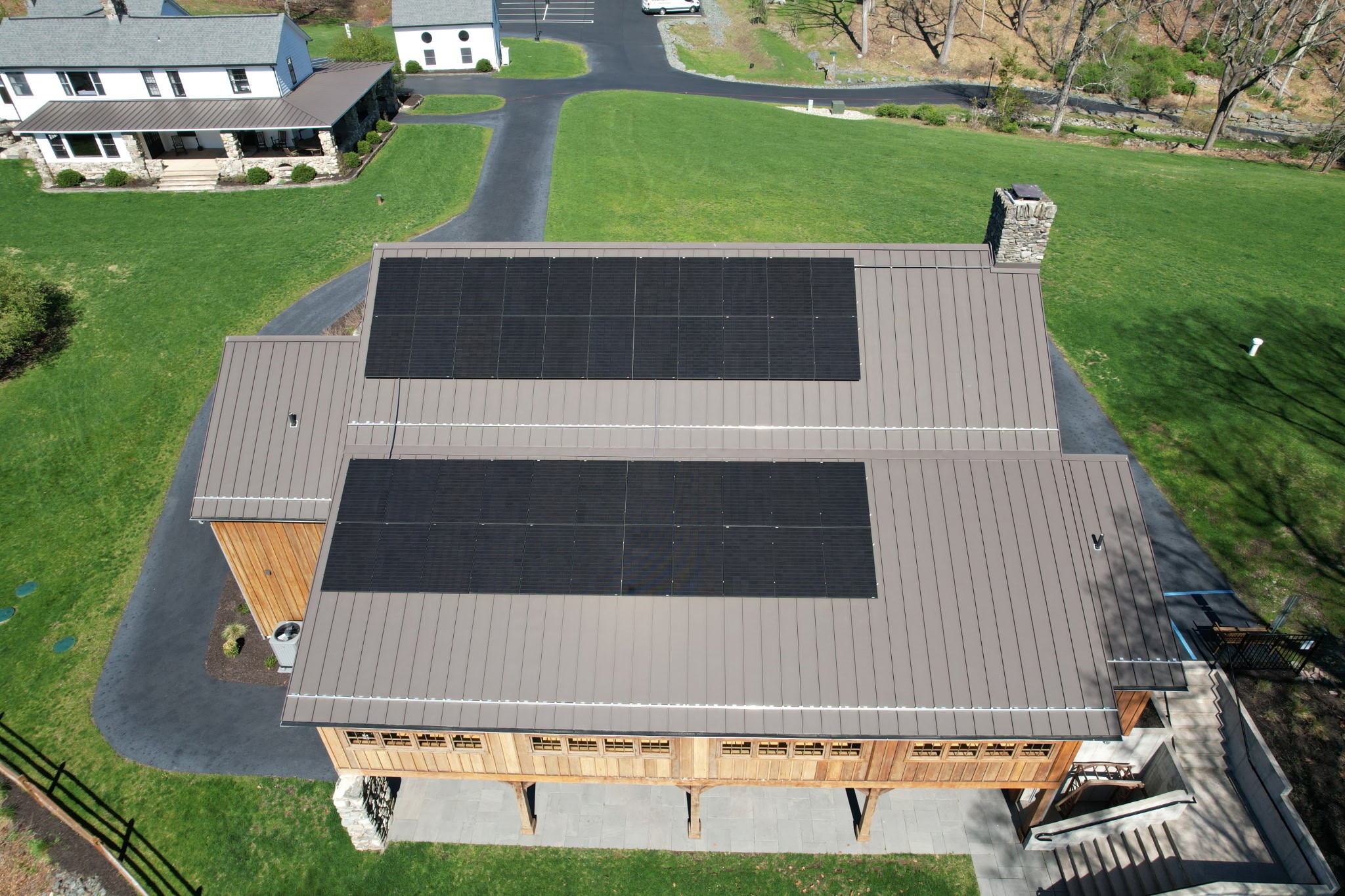
Finished ground mounts from this footprint are on our projects page. If you want us to look at yours, send the address and tell us which utility bills you or call the office at (570) 500-2327. We will tell you honestly if the roof is the better answer.
What we would tell a homeowner considering this
- A ground mount trades site work for orientation, tilt and easy access. The trench length and the soil decide whether that trade is worth making.
- Footings bear below the frost line, and the depth that counts is the one the building code official for your municipality enforces. Get it in writing, not from a chart.
- Setbacks for a ground mount come from your township or borough zoning ordinance, and from your homeowners association if you have one. Check the association first, it is usually the slower gate.
- One-call notice is required by law before digging, and it does not mark your septic lateral, your well line or the feed you ran to the barn. Tell us what you buried.
- Open ground removes the natural size limit a roof imposes. Pennsylvania net metering rules still care how big the system is relative to what you use.